
Damaged Kali Idol Sparks TMC-BJP Clash in West Bengal
On October 22 2025, the discovery of a severely damaged idol of Goddess Kali in a village temple in the South 24 Parganas district of West Bengal suddenly ignited a storm of protests, road blockades and a sharp political confrontation between the ruling Trinamool Congress (TMC) and the opposition Bharatiya Janata Party (BJP).
This incident, which appears on the surface as a religious act of vandalism, rapidly morphed into an explosive symbol of alleged governmental failure, communal tension and upcoming electoral stakes.
In this blog we will unpack the incident, trace its layers of religious sentiment, political blame-game, law-and-order implications and what it means for West Bengal’s social fabric and the 2026 elections.
What happened? The incident in Kakdwip
Location & discovery
The incident took place in a village under the jurisdiction of Suryanagar Gram Panchayat in the Kakdwip Assembly Constituency (a part of South 24 Parganas district).
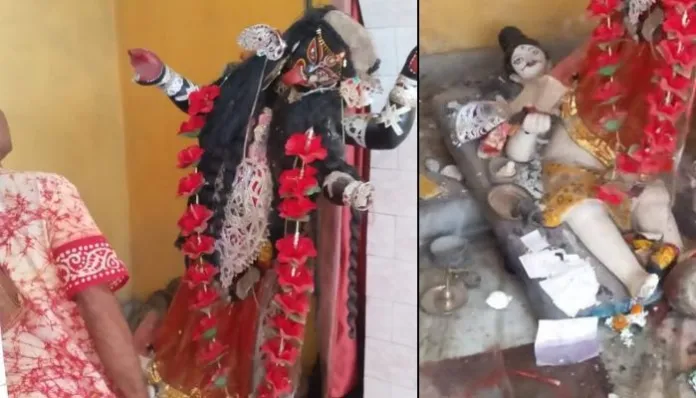
Locals discovered the head of the idol of Goddess Kali had been severed; the idol was found damaged early in the morning.
Immediate public reaction
On discovering the vandalised idol, local residents were enraged. They staged protests, blocked a national highway, refused to allow the immersion of the idol — turning a religious ritual into a mass political demonstration.
According to police, ambulances and emergency services were held up by the blockade.
Law-enforcement response
Additional forces were deployed to calm the situation, and an investigation was initiated. The police also urged the public not to believe in “misinformation” being spread.
One controversial point: The idol was reportedly taken away in a “prison van,” which inflamed further anger and accusations of a cover-up.
The political dimension: TMC vs BJP
BJP’s accusations
The BJP quickly seized on the incident to accuse the TMC-led state government of administrative apathy and of shielding the perpetrators.
For example, BJP leader Suvendu Adhikari alleged that “jihadi elements” were behind the act and claimed the state is being turned into “West Bangladesh”.
Another BJP leader, Amit Malviya, claimed that the police “took away Maa Kali in a prison van! Shame, shame — there is no place to hide this disgrace.”
TMC’s defence
The TMC and the state police dismissed many of the BJP’s claims as politically motivated and warned against communalising the incident.
A local TMC leader said: “Let police complete the probe. We condemn any attempt to disturb the harmony in this area.” The Tribune
Underlying electoral stakes
With West Bengal positioned for its next Assembly election in 2026, every incident involving religious sentiment or law-and-order becomes magnified. The BJP’s ability to frame the event as a failure of the TMC government boosts their electoral narrative; conversely for TMC, the risk is perception of governance breakdown and communal unrest.
Religious & socio-cultural implications
Importance of Kali worship in Bengal
Worship of Goddess Kali has deep roots in Bengal’s devotional traditions. An act of vandalising a Kali idol does not remain restricted to physical damage—it triggers deep emotional response among devotees.
Therefore, this incident is much more than property damage; it taps into identity, faith and cultural pride.
Impact on communal harmony
When religious symbols are attacked, the potential for communal tension escalates quickly. Locals here believed the idol vandalisation was not a mere mischief but a targeted act. The resulting highway blockade and clash with police reflect that sensitivity.
The police’s call to avoid believing misinformation underlines how quickly such incidents can be hijacked into communal flashpoints.
The emotional toll on the local community
For villagers of Suryanagar and surrounding areas, the act potentially erodes trust—trust in the temple, trust in police protection, trust in community harmony. One report quotes a local:
“We are peace-loving people. But if the administration does not catch the guilty, this anger will spill onto the streets. Our goddess’s head was broken—this is not just a statue; it is an attack on our existence.” Hindu Voice
What makes this incident particularly explosive?
- Symbolic gravity: Vandalism of a religious idol strikes at emotional nerve.
- Visible protest: Blocking a national highway means attention across media—not just local coverage.
- Political weaponisation: The incident swiftly became ammunition for political parties with elections looming.
- Media virality: Video clips, social-media posts and testimonies circulated online, amplifying perceptions of injustice, cover-up or threat.
- Law-order test: State police and government response are under scrutiny – tardiness or perceived bias fuels backlash.
What’s next: Investigation, implications & possibilities
Investigation to date
- Police have allegedly located the damaged idol and initiated a probe.
- Efforts to identify perpetrators, but no public disclosure of arrests yet.
- Local security has been tightened; additional personnel deployed.
What to watch
- Will the culprits be identified and arrested?
- Will the state government and police restore confidence among locals?
- Will communal tension spread to adjacent villages or districts?
- How will opposition parties leverage this for political gain?
- What narrative will the media adopt – cover-up, communal attack, mere vandalism?
- How will this factor into West Bengal’s 2026 election dynamics?
Broader implications
- If left unaddressed, the incident can damage the state’s image for rule-of-law, communal harmony and religious freedom.
- It could deepen fault-lines between communities, especially in sensitive regions near the Sundarbans and border areas.
- Politically: a momentum shifter. For BJP, a rallying cry; for TMC, potential liability.
- Societally: raises questions about protection of minorities and majorities alike, handling of religious sites, policing in rural areas.
The human interest angle
Beyond the sensational headlines, there are real people affected: the priest of the temple, the local villagers who discovered the damage, those who blocked the highway, the families whose ambulances were stuck, the devotees deprived of normal ritual immersion.
Their pain, anger and demand for justice form the heartbeat of this story. In a small village under the Sundarbans, an act of vandalism triggered voices demanding dignity, order and accountability.
Lessons and take-aways
- Timely response matters: Faster identification of culprits and transparent communication could prevent escalation.
- Information management: In the age of social media, rumours spread fast; authorities must proactively engage.
- Religious sensitivity demands priority: Vandalism of sacred icons is not just a crime – it’s a social flashpoint.
- Political climate matters: In election-prone zones, such incidents get amplified; governments must anticipate and manage accordingly.
- Community engagement is crucial: Local leadership, resident trust and civic participation can defuse tension.
FAQs
Q1: Where exactly did the incident happen?
It occurred in a village under Suryanagar Gram Panchayat, Kakdwip Assembly Constituency, South 24 Parganas district, West Bengal.
Q2: What was damaged?
The idol of Goddess Kali was found with its head severed/damaged.
Q3: Who found it and when?
Local villagers discovered the damage in the early morning of October 22 2025.
Q4: How did the protest escalate?
Villagers blocked a national highway, refused idol immersion, and clashed with police who used minimum force.
Q5: What is the BJP’s allegation?
They allege that the TMC government is responsible for the breakdown of law-and-order and that the incident reflects “appeasement politics.”
Q6: What is the TMC’s response?
They claim the BJP is communalising the incident, that investigations are underway, and urge peace and calm.
Q7: Is there evidence of communal motive?
While BJP leaders allege involvement of “jihadi elements,” police have so far only confirmed vandalism and say investigations are ongoing.
Q8: What could be the electoral consequences?
Given West Bengal’s upcoming 2026 elections, this incident could shift voter sentiment, influence turnout among key communities, and shape narratives of governance vs. lawlessness.
Conclusion
The damaged Kali idol in Kakdwip has evolved into far more than a temple mishap—it is a micro-cosm of West Bengal’s larger socio-political fault-lines: faith and identity, governance and neglect, political contention and grassroots anger.
For the villagers, it is about justice and ritual sanctity. For the government, it is a test of administrative credibility. For the opposition, it is a powerful campaign slogan. And for the state as a whole, it is a moment that will linger well beyond the headlines.
As the investigation unfolds, all eyes will be on whether justice is delivered swiftly, whether communal calm holds, and whether this incident becomes a turning point or just another page in Bengal’s evolving story.