
🎬 The Platform (El Hoyo)
Release Year: 2019
Streaming Platform: Netflix
⭐ IMDb: 7.0/10 | 🍅 Rotten Tomatoes: 81%
The Platform (2019) Movie Explained & Ending Explained

1. The Platform Movie Explained: The Brutal Truth About The Ending
Galder Gaztelu-Urrutia’s 2019 Spanish film,The Platform(original title:El Hoyo), is not just a movie; it is a visceral experience that traps you in a concrete nightmare. Released on Netflix at the onset of a global pandemic, the film’s themes of scarcity and survival felt eerily prescient. It is a brutal, dystopian thriller that uses the simple premise of a vertical prison to create a complex and bloody allegory for society.
In thisThe Platform Movie Explainedguide, we will descend level by level to unpack the story, analyze the key characters, and most importantly, deliver a comprehensiveThe Platform Ending Explained. We will look at the symbolism, the social commentary, and the ambiguous final moments to help you understand why this film has become a modern cult classic.
2. Overview
The Platformis a Spanish sci-fi horror film directed by Galder Gaztelu-Urrutia. It is set in a towering prison facility known as “The Hole” or “The Vertical Self-Management Center.” The rules are simple: there are two inmates per level, and once a day, a platform laden with a grand feast descends from the top. It stops on each level for a few minutes, allowing those on the upper floors to eat their fill. By the time it reaches the bottom, nothing is left.
The tone is claustrophobic, grim, and unrelenting. With a runtime of just 94 minutes, the movie wastes no time throwing the viewer—and the protagonist—into this horrifying reality.
3. SPOILER WARNING
4. Story Explained (Full Breakdown)
The narrative is a continuous descent, mirroring the platform itself.
Act 1: The Awakening
We meet Goreng (Iván Massagué), a middle-aged man who voluntarily enters the facility in exchange for a diploma. He wakes up on Level 48 with Trimagasi (Zorion Eguileor), a grizzled, pragmatic inmate who quickly explains the brutal hierarchy. Trimagasi has been on lower levels and confesses to having resorted to cannibalism to survive. This act establishes the stakes: here, you either eat, are eaten, or become a cannibal.
Act 2: The Descent and the Idealist
After being gassed and waking on lower levels, Goreng finds himself tied up, with Trimagasi intending to butcher him for food. He is saved by Miharu (Alexandra Masangkay), a mysterious woman who rides the platform down daily, searching for her child. Goreng kills Trimagasi and is forced to eat his flesh, haunted by guilt.
In his next cell, he meets Imoguiri (Antonia San Juan), the administrator who originally signed him up. She is terminally ill and entered the pit to create change. She introduces the concept of “rationing” and selfless cooperation, arguing that if everyone ate only what they needed, the food would reach the bottom. Goreng tries to enforce this, but his efforts are local and temporary.
Act 3: The Mission
After Imoguiri’s suicide, Goreng wakes on Level 6 with Baharat (Emilio Buale), a strong, pragmatic man. Inspired by Imoguiri’s ideals, Goreng proposes a radical plan: they will ride the platform down to the very bottom, rationing food and forcing cooperation at every level. Their goal is to get food to the last person. They encounter a “wise man” named Sr. Brambang, who suggests a symbolic act: send an untouched dish—a perfect panna cotta—back to the top as a “message” to the Administration.

5. Key Themes Explained
The Platformis a dense web of metaphors.
- Capitalism and Class Struggle:This is the most overt theme. The pit is a direct representation of societal hierarchy. The upper class (low-level numbers) overconsume and waste resources, leaving nothing for the proletariat at the bottom. The system encourages selfishness, pitting people against each other rather than against the system itself.
- Human Nature vs. System:The film asks a crucial question: Is the cruelty a result of the system, or is the system a reflection of our inherent nature? When prisoners move to higher levels, they immediately forget the suffering of the lower floors, indicating that selfishness is a deeply ingrained survival instinct.
- Religion and Sacrifice:The number 333 (the bottom level) is a clear inversion of 666, often associated with the beast. Goreng is repeatedly referred to as a “messiah” figure, sacrificing himself and carrying a “message.” His companions can be seen as disciples, and the act of eating flesh and drinking blood (cannibalism) is a dark mirror of the Eucharist.
6. Characters Explained
- Goreng (Iván Massagué):The everyman. He enters naive and hopeful (wanting to readDon Quixote, a story about idealism) but is slowly brutalized by the system. He represents the potential for change that exists in everyone, but also the physical and moral degradation required to fight the machine.
- Trimagasi (Zorion Eguileor):The realist and the devil on Goreng’s shoulder. He represents the survival instinct at its most primal. He adapts to the system, using it to justify murder and cannibalism.
- Imoguiri (Antonia San Juan):The idealist and the angel. She is the moral compass of the film, believing that voluntary cooperation can fix the system. Her death signifies the crushing of naive hope by the brutal reality.
- Miharu (Alexandra Masangkay):The mystery. She is driven by love (for her child), which makes her fierce and relentless. She is one of the few characters whose motivation is entirely selfless.
- Baharat (Emilio Buale):The disciple. He is strong and initially skeptical but becomes a true believer in Goreng’s mission, ultimately giving his life for it.
7. Twist Explained
WhileThe Platformis more allegorical than twist-driven, there is a significant revelation in the third act regarding the child. For the entire film, we are led to believe that Miharu is a mother desperately searching for her lost child. However, Imoguiri reveals that there are no children in the pit and that Miharu is actually an aspiring actress who entered voluntarily. This casts doubt on everything we thought we knew about the pit’s rules. But the final twist is thatthere is a child at the bottom. This suggests that either Imoguiri was wrong, or that the child is not a physical being but a symbol, appearing only when the conditions are right.
8. Movie Ending Explained
This is the most debated part of the film, so let’s break downThe Platform Ending Explainedin detail.
What Exactly Happens?
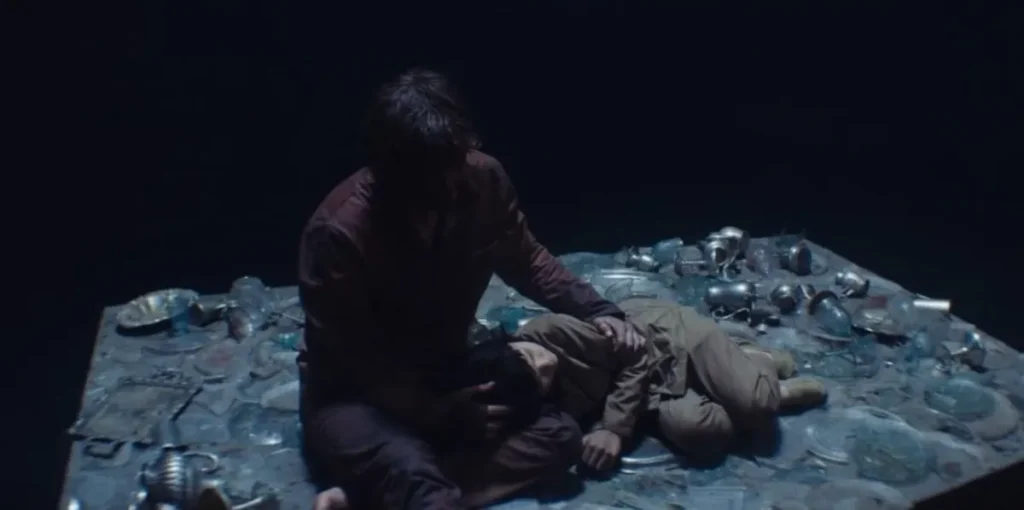
Goreng and Baharat make it to Level 333. They are mortally wounded and discover a young girl—Miharu’s daughter—sitting alone. Baharat initially wants to stick to the plan and send the panna cotta up as a message. But looking at the girl, he realizes thatsheis the message. He feeds her the dessert.
Goreng has a dream where Baharat tells him, “The girl is the message.” He wakes to find Baharat dead. He puts the girl on the platform, and they descend to a dark, abyssal bottom. Goreng steps off into the darkness, where the hallucination of Trimagasi greets him, telling him, “The message requires no bearer.” The girl then ascends alone on the platform.
What the Ending Means
- The Girl as Hope:The girl represents innocence, the future, and the possibility of a world uncorrupted by the system. By saving her, Goreng is not sending a political treatise to the Administration; he is sending something the Administration cannot ignore: proof of humanity’s capacity for selfless love.
- The Panna Cotta vs. The Girl:The panna cotta is a symbol of protest. The girl is a symbol of transcendence. The message shifts from “look at what we demand” (the food) to “look at what you have destroyed, and what we can still save” (the child). It is a far more powerful indictment of the system.
- “The message requires no bearer”:Trimagasi’s final line suggests that once the girl is on her way up, Goreng’s role is finished. The truth is now out there. He doesn’t need to survive to deliver it. He can finally let go of his physical self and the trauma of the pit. He walks into the void, possibly dying, but at peace.
- Ambiguity:The ending is intentionally open. We don’t know if the Administration sees the girl, if she gets crushed, or if the system changes. The director, Galder Gaztelu-Urrutia, leaves it up to us to decide if a single act of kindness can truly dismantle a brutal machine. The message is about theattemptitself.

9. Performances
The cast delivers raw, physical performances that sell the horror.
- Iván Massaguéis a revelation. Known for comedy, he underwent a dramatic physical transformation, losing a significant amount of weight during the chronological shoot to realistically portray starvation. His eyes convey a deep sadness that grounds the film.
- Zorion Eguileoris genuinely terrifying as Trimagasi. He brings a chilling calmness to the character, making his threats of cannibalism feel disturbingly rational.
- Antonia San Juanprovides the film’s brief moments of warmth, making her eventual fate all the more tragic.
- Emilio Bualeholds his own as the physically imposing yet ultimately faithful Baharat, creating a powerful dynamic with Massagué.
10. Direction & Visuals
Director Galder Gaztelu-Urrutia masterfully maximizes a limited budget.
- Production Design:The concrete cells are stark, brutal, and identical, emphasizing the prisoners’ insignificance. The hole in the center of each cell allows the characters (and the audience) to see the infinite abyss above and below, creating a constant sense of vertigo and dread.
- Color Palette:The film contrasts the sterile grey of the prison with the vibrant, almost erotic opulence of the food on the platform. This visual clash highlights the obscene inequality at the heart of the story.
- Cinematography:The camera work is claustrophobic but inventive, often looking straight up or down to remind us of the endless tiers of suffering.
11. Pros and Cons
Pros:
- High Concept:A brilliant, easy-to-grasp metaphor that is executed perfectly.
- Engaging:Despite the setting, the story is compelling and fast-paced.
- Thought-Provoking:It stays with you long after the credits roll, sparking debate about society and human nature.
- Practical Effects:The gore and violence are impactful and serve the story.
Cons:
- Characters as Symbols:Some critics argue that characters are more archetypes than fully fleshed-out people, which can make emotional investment difficult for some viewers.
- Lack of World-Building:We never learn why the prison exists or who the Administration is. While this is intentional (they are a faceless power), it can be frustrating.
- Plot Convenience:The odds of Goreng meeting the same people on different levels stretch believability.
12. Cast
| Actor | Character | Description |
|---|---|---|
| Iván Massagué | Goreng | The protagonist, a volunteer seeking a diploma. |
| Zorion Eguileor | Trimagasi | Goreng’s first, cannibalistic cellmate. |
| Antonia San Juan | Imoguiri | The administrator who enters the pit. |
| Emilio Buale | Baharat | Goreng’s final ally on Level 6. |
| Alexandra Masangkay | Miharu | The woman searching for her child. |
13. Crew
| Role | Name |
|---|---|
| Director | Galder Gaztelu-Urrutia |
| Screenplay | David Desola, Pedro Rivero |
| Story by | David Desola |
| Cinematography | Jon D. Domínguez |
| Music | Aranzazu Calleja |
14. Who Should Watch?
- Fans of Smart Sci-Fi:If you likedSnowpiercer,Cube, orCircle, this is a must-watch.
- Viewers Who Enjoy Social Commentary:This is a film for those who like their entertainment mixed with political and philosophical questions.
- Not for the Squeamish:If you are sensitive to graphic violence, gore, or themes of cannibalism, this movie will be a very difficult watch.
15. Verdict
The Platformis a brutal, brilliant, and bloody allegory that uses its simple premise to maximum effect. It is not a comfortable watch, but it is a necessary one for fans of dystopian fiction. Director Galder Gaztelu-Urrutia creates a world that is terrifyingly logical and holds a mirror up to our own society’s inequalities. While the ending is ambiguous, it is that very ambiguity that makes it powerful, forcing us to ask ourselves if we believe change is possible. It is a gripping, disgusting, and unforgettable cinematic experience.
16. Reviews & Rankings
The Platformreceived widespread critical acclaim upon its release, particularly for its originality.
- Rotten Tomatoes:81% (Critics) / 71% (Audience)
- Metacritic:73/100 (Generally Favorable)
- Common Praise:“Inventive,” “Captivating,” “A sharp commentary on social inequality”.
17. Where to Watch
Ready to descend intoThe Hole? You can currently streamThe Platformexclusively onNetflix.
[Watch The Platform on Netflix]
🍽️ THE PLATFORM [2019]
10 things you were afraid to ask · visible & discoverable
The Platform (El hoyo) is a 2019 Spanish sci-fi horror film. It’s set in a vertical tower where inmates are placed in cells (two per level). A food platform descends from the top, stopping at each level for a few minutes. Those at the top feast, those at the bottom starve. It’s a brutal allegory about capitalism, inequality, and human selfishness.
Directed by Galder Gaztelu-Urrutia, a Basque filmmaker. The Platform was his feature debut — and it became a global phenomenon on Netflix.
Every inmate wears a shirt with a number. It indicates the floor level where they entered. But after each monthly reset, inmates are randomly reassigned a new level — the number stays, representing their starting point (social class).
The child (Miharu) represents innocence and the future. She appears on the lower levels, desperately looking for her mother. Many interpret her as a symbol of hope — or the last chance to break the cycle of indifference.
Okinawa is a dessert (a jelly-like dish) that appears several times. The protagonist, Goreng, wants to send a panna cotta message back to the top. The panna cotta contains a hair and a message — an attempt to communicate with the administration.
Spoiler: Goreng and his cellmate reach level 0, but find only a little girl (the child). Goreng decides to stay and sends the child up with the platform. The ending is ambiguous: is the child hope? Or a sign that the system can’t be changed? The director said the ending is optimistic — the message (solidarity) finally reaches the top.
It’s often compared to Cube (1997), Snowpiercer, or The Belko Experiment. While not officially connected, it belongs to the “vertical thriller / social horror” subgenre. A sequel, The Platform 2, was announced in 2023 and is in production.
The tower is said to have 333 levels, with 2 inmates per cell. In the movie, the protagonist descends as far as level 200+. The exact total is part of the mystery — some say it’s infinite.
Survival depends on the level and your cellmate. Some try self‑regulation (only eating what they need). Others turn to cannibalism. The “message” Goreng tries to send is that the only way to survive together is to share equally — but the system corrupts that idea.
The movie is available on Netflix in most regions. It’s also available on Blu‑ray and various VOD platforms (Amazon Prime Video, Apple TV, etc.). The original title is El hoyo.