
🎬 Primal Fear
Release Year: 1996
Streaming Platform: Paramount+
⭐ IMDb: 7.7/10 | 🍅 Rotten Tomatoes: 77%

🎬 PRIMAL FEAR 1996
⚡ plus multiple critics circles wins for Edward Norton in his film debut. 📋 IMDb [citation:1] 📚 Wikipedia [citation:2]
In the pantheon of 1990s legal thrillers,Primal Fearstands tall—not just for its gripping courtroom drama, but for a final twist that left audiences speechless. Directed by Gregory Hoblit, this 1996 film starsRichard Gereas a cocky Chicago defense attorney and introduces the world toEdward Nortonin a blistering debut performance. If you are looking for aPrimal Fear movie explainedbreakdown that uncovers every layer of its genius, you have come to the right place.
This article will walk you through the entire story, analyze its complex characters, and most importantly, deliver a comprehensivePrimal Fear ending explained. We will dissect how the film uses psychology, trauma, and manipulation to create one of cinema’s most unforgettable conclusions. Whether you are revisiting it or watching for the first time, get ready to see Aaron Stampler in a whole new light.
Overview
Primal Fearis a crime drama and legal mystery thriller that runs for 130 minutes. The film follows Martin Vail (Richard Gere), a narcissistic but brilliant defense attorney who thrives on media attention. He takes on the pro bono case of Aaron Stampler (Edward Norton), a meek, stuttering altar boy from Kentucky accused of brutally murdering Chicago’s beloved Archbishop Rushman.
The mood is dark, tense, and rainy—classic Chicago noir. It explores themes of justice, performance, and the nature of evil. While it functions as a procedural thriller, its real power lies in its character studies and the shocking revelation that rewrites everything you thought you knew.
⚠️ SPOILER WARNING: Major Plot Details Ahead
If you have not seenPrimal Fear, stop here. We are about to reveal the film’s iconic ending and the twists that make it legendary. You have been warned.
Story Explained (Full Breakdown)
Act 1: The Crime and the Lawyer
The film opens with the gruesome murder of Archbishop Rushman. His body is mutilated, with a mysterious code carved into his chest. Aaron Stampler is seen fleeing the scene, covered in blood, and is captured during a televised chase. The media dubs him “The Butcher Boy of St. Mike’s.”
Enter Martin Vail. He is a high-profile defense attorney who loves the spotlight. He volunteers to defend Aaron for free, not because he believes in his innocence, but because the case guarantees national attention. Vail meets Aaron, who presents himself as a gentle, God-fearing boy with a severe stutter and no memory of the crime. Vail is intrigued.
Act 2: Uncovering the Truth
As Vail and his investigator, Tommy Goodman (Andre Braugher), dig deeper, they discover the Archbishop was not a saint. He was involved in shady land deals that cost powerful people—including the State’s Attorney, John Shaughnessy (John Mahoney)—millions of dollars. More disturbingly, they find a hidden videotape showing the Archbishop sexually abusing Aaron and his girlfriend, Linda.
When Vail confronts Aaron with this tape, Aaron’s personality violently shifts. His stutter vanishes. His posture changes. “Roy” emerges—a confident, aggressive, and murderous alter ego. Roy admits to killing the Archbishop but threatens Vail to stay out of his way. Just as suddenly, Aaron returns, completely unaware of what just happened. Dr. Molly Arrington (Frances McDormand), a psychologist, diagnoses Aaron with Dissociative Identity Disorder (DID), caused by years of horrific abuse.
Act 3: The Trial and the Trap
Vail is in a legal bind. He initially pleaded not guilty, but now has evidence of insanity. To force the issue, he baits prosecutor Janet Venable (Laura Linney), his ex-girlfriend, into using the sex tape. This exposes the Archbishop’s corruption and humanizes Aaron.
The masterstroke comes when Vail puts Aaron on the stand. He intentionally triggers Aaron, hoping “Roy” will appear in front of the jury. It works—but better than expected. Roy explodes, attacks Venable, and nearly kills her. The judge halts the trial and delivers a verdict of “not guilty by reason of insanity.” Aaron will be sent to a mental hospital, not death row. Vail has won.
Key Themes Explained
Primal Fearis more than a twist movie. It is a deep exploration of perception versus reality.
- Duality and Performance:The film constantly asks, “Who is the real person?” Aaron wears a face of innocence, but it is a costume. The Archbishop wore a face of piety, but he was a predator. Even Vail wears the mask of an arrogant lawyer to hide his growing conscience. The film suggests that we all perform versions of ourselves.
- Manipulation of the System:The entire legal system is shown as a game. It is not about truth; it is about who tells the better story. Vail plays the game and wins, only to realize he was the pawn, not the player.
- Trauma and Evil:The movie complicates our understanding of victims. Aaron is a victim of horrific abuse. But instead of using that trauma to explain his actions, the film twists it into a motive for cold-blooded murder, raising uncomfortable questions about innocence and evil.
Characters Explained
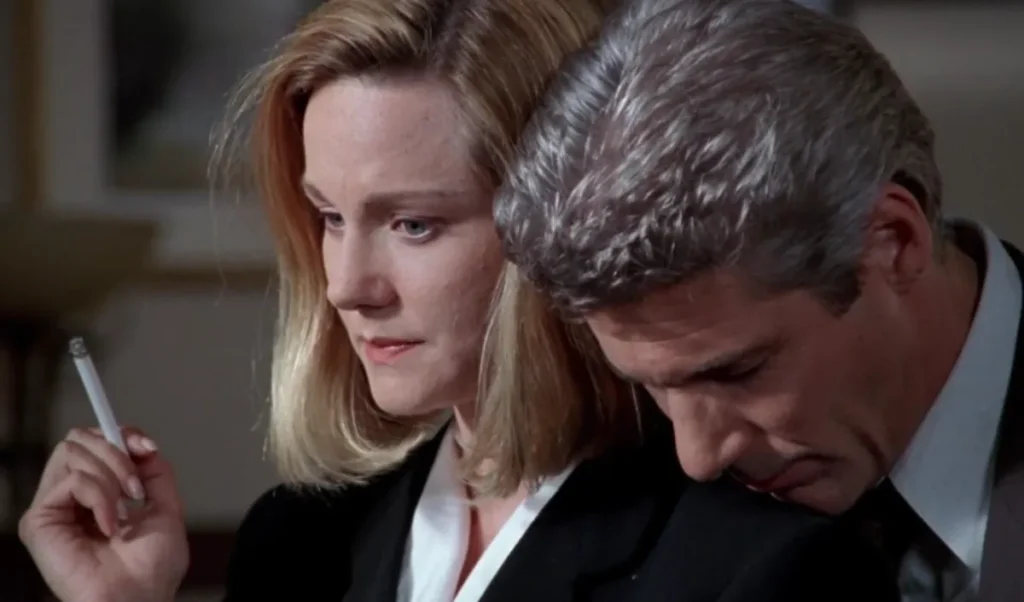
- Martin Vail (Richard Gere):He is arrogant, media-hungry, and brilliant. He believes he can control every variable. His arc is one of humiliation; he is so confident in his ability to read people that he is blind to the truth right in front of him. Gere brings a weary charm to the role, making his final defeat all the more powerful.
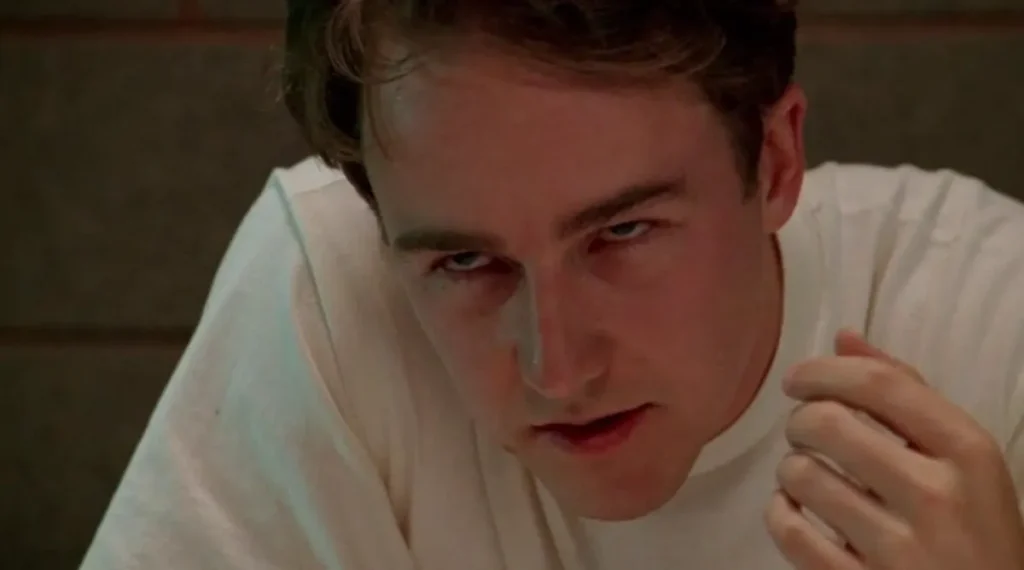
- Aaron Stampler / Roy (Edward Norton):This is a dual role for the ages. “Aaron” is soft, scared, and sympathetic. “Roy” is vicious, confident, and cruel. Norton disappears into both parts. He makes you believe in the split personality completely, which is why the final reveal is so devastating. It is not just a trick on Vail; it is a trick on the audience.
- Janet Venable (Laura Linney):As the prosecutor, she is Vail’s equal in skill but carries the weight of being his former lover. She is competent and fierce, but the film uses her as a tool—first for Vail’s strategy, and then as a victim of Roy’s violence.
- Dr. Molly Arrington (Frances McDormand):She represents the voice of psychology and reason. She believes in Aaron’s disorder, which reinforces the lie for both Vail and the viewer.
Twist Explained
The central twist is that there was never any “Roy.”
Aaron Stampler fabricated the entire Dissociative Identity Disorder. He is not a broken boy with a split mind; he is a brilliant sociopath who meticulously planned his escape. He murdered the Archbishop—and later, we learn he also killed his girlfriend Linda—because they abused him. But instead of facing justice, he chose to perform madness.
He studied how to fake a stutter. He observed how to simulate a personality shift. He played the role of “Aaron” to gain Vail’s sympathy and “Roy” to scare him off. It was a performance so perfect that it fooled a top psychologist, a savvy defense attorney, and the entire court. The “twist” is not just that he is guilty; it is that his innocence was a work of fiction.
Movie Ending Explained
This is the moment that definesPrimal Fear. Let us break down what happens, step by step, in the final scene.
What Exactly Happens
After the trial, Vail visits Aaron in his cell to say goodbye. Aaron is back to being the sweet, stuttering boy. Vail tells him he will be in a hospital for a few years and then released. Aaron thanks him, looking relieved. As Vail turns to leave, Aaron says, “I’m sorry about Ms. Venable’s neck. I hope she’s gonna be okay.”
Vail freezes. He turns around slowly. “How did you know about her neck?” he asks. The news reports only said she was attacked; no specific details about her neck injury were released to the public.
Aaron looks up. His face changes. The stutter is gone. The fear is gone. In a calm, clear voice, he asks, “There never was an Aaron, was there, Martin?”
Vail stands there, stunned. He has been played. The boy he defended, the victim he believed in, never existed. Aaron (or whoever he really is) smiles slightly, acknowledging Vail’s realization. Vail walks out of the prison, his confidence shattered, his worldview rocked.
What the Ending Means
The ending is a complete inversion of the film’s moral compass. Vail entered the case believing in the system, believing in his own intellect, and believing in Aaron’s victimhood. He leaves with nothing.
The title,Primal Fear, refers to the most basic human fear: the fear of being fooled, the fear that the person standing in front of you is not who they appear to be. Vail’s primal fear is realized. He cannot trust his own judgment.
Alternate Angle Interpretations
Some critics have pointed out that the ending, while thrilling, carries a problematic message. By having the “crazy” character actually be a faker, the film implies that mental illness is a con or a tool for villainy. It paints an ugly picture of Dissociative Identity Disorder, suggesting that those who suffer from it are not to be trusted. While this reading adds a layer of cultural criticism, within the context of the film, it serves to maximize the shock value of Aaron’s betrayal.
Director’s Intention
Director Gregory Hoblit and starRichard Gerefought to keep this ending. According toEdward Norton, the studio was nervous about ending the film with the hero losing. Gere insisted, knowing that the defeat of his character was the only way to honor the story. The ending is meant to leave the audience feeling just as violated and tricked as Vail.
Performances
- Edward Nortonis the reason this movie endures. In his first film role, he delivers a masterclass in misdirection. He makes you care for Aaron, fear Roy, and then hate him for his cunning. He deserved every award nomination he received.
- Richard Geregives one of his most underrated performances. He plays arrogance with a wink, but when the truth hits, his silent realization is heartbreaking. He allows himself to be the fool for the sake of the story.
- Laura Linneyholds her own against two heavyweights. Her character is somewhat underwritten, but she injects Venable with intelligence and wounded pride.
- John Mahoney(Frasier’s Martin Crane) is perfectly slimy as the corrupt State’s Attorney.
Direction & Visuals
Gregory Hoblit, coming from television (NYPD Blue), brings a gritty, realistic texture to the film. The Chicago setting is used perfectly—the rain-slicked streets mirror the moral murkiness of the plot.
The cinematography by Michael Chapman uses a muted color palette of grays and browns. This makes the few moments of color (like the red of blood or the bright lights of the courtroom) pop with intensity. The camera often lingers on Norton’s face during his transformations, forcing us to watch the lie unfold in real time.
Pros and Cons
Pros:
- Edward Norton’s performance:Worth the price of admission alone.
- The Twist:Holds up even after multiple viewings.
- Pacing:The film moves quickly, balancing investigation and courtroom drama perfectly.
Cons:
- The Romance Subplot:The history between Vail and Venable feels like a checkbox and doesn’t add much.
- Problematic Portrayal:Modern viewers may struggle with the film’s use of DID as a simple plot device for a villain.
- Supporting Characters:Some roles, like Andre Braugher’s investigator, are underutilized.
Cast
| Actor | Character |
|---|---|
| Richard Gere | Martin Vail |
| Edward Norton | Aaron Stampler / Roy |
| Laura Linney | Janet Venable |
| John Mahoney | John Shaughnessy |
| Frances McDormand | Dr. Molly Arrington |
| Alfre Woodard | Judge Miriam Shoat |
| Andre Braugher | Tommy Goodman |
| Maura Tierney | Naomi |
Crew
| Crew Member | Role |
|---|---|
| Gregory Hoblit | Director |
| Steve Shagan & Ann Biderman | Screenwriters |
| Gary Lucchesi & Hawk Koch | Producers |
| Michael Chapman | Cinematography |
| James Newton Howard | Music Composer |
| David Rosenbloom | Editor |
Who Should Watch?
If you love courtroom dramas likeA Few Good Menor psychological thrillers likeThe Usual Suspects,Primal Fearis essential viewing. It is perfect for fans of smart, dialogue-driven movies where the twist is earned, not cheap. If you appreciate debut performances that launch legendary careers, you cannot miss Edward Norton here.
Verdict
Primal Fearis a classic for a reason. It takes a familiar genre and injects it with a shot of pure adrenaline in its final moments. While it may rely on tropes of the 90s thriller, the power of its performances—specifically Edward Norton’s astonishing debut—elevates it to must-watch status. It is a cynical movie about a cynical system, and its ending remains one of the most memorable stingers in cinema history. You will never look at a stutter the same way again.
Reviews & Rankings
| Source | Rating / Score |
|---|---|
| IMDb | 7.7/10 |
| Rotten Tomatoes (Critics) | 77% |
| Rotten Tomatoes (Audience) | 92% |
| Roger Ebert | 3.5/4 Stars |
| Metacritic | 47 (Mixed/Average) |
Where to Watch
You can currently streamPrimal FearonParamount+. It is also available for digital rental or purchase on platforms like Amazon Prime Video, Apple TV, and YouTube.
🎬 PRIMAL FEAR (1996) 🔥
- What is the basic plot of Primal Fear?A high‑profile lawyer (Richard Gere) defends an altar boy (Edward Norton) accused of murdering a popular Chicago archbishop. As the case unfolds, secrets, multiple personalities, and shocking twists surface. The film is based on William Diehl’s 1993 novel.
- Who plays Aaron Stampler / Roy?Edward Norton in his breathtaking film debut. He plays the stuttering, gentle Aaron and the cold‑blooded alter ego Roy. The role earned him a Golden Globe and an Oscar nomination.
- Who directed Primal Fear, and when was it released?Directed by Gregory Hoblit (in his feature film debut). It premiered on April 3, 1996 in the US. The film became a sleeper hit, grossing over $102 million worldwide.
- Is Primal Fear based on a true story?No, it’s adapted from William Diehl’s novel. However, it explores the real‑life legal concept of dissociative identity disorder (DID) as a defense, which was highly publicized in the 1990s.
- What does the title “Primal Fear” mean?It refers to the most basic, instinctive fear—often of death or violence. In the film, it ties to the survival instinct that shapes Aaron’s fractured psyche. Also the name of a fictitious band in the movie.
- What is the famous ending twist?⚠️ Spoiler: After being found not guilty by reason of insanity, Aaron reveals to his lawyer that his dissociative identity was an act. The cold “Roy” persona was the real Aaron all along. The final line: “There never was an Aaron, you fucking idiot.”
- Who plays Martin Vail (the lawyer)?Richard Gere as the ambitious, media‑loving Chicago defense attorney Martin Vail. It’s one of his most acclaimed dramatic roles.
- Was the movie a box office success?Absolutely. Produced on a $30 million budget, it grossed more than $102 million worldwide. It also received strong reviews, especially for Norton’s performance.
- Did Edward Norton do his own stuttering?Yes, Norton meticulously developed the stutter and the physicality of Aaron. He visited psychiatric hospitals and studied patients with dissociative disorders to prepare. The transformation is entirely his.
- Where can I watch Primal Fear (1996) now?It’s currently available for digital rental or purchase on platforms like Amazon Prime Video, Apple TV, YouTube Movies, and sometimes streams on Paramount+ or Showtime (depending on your region).