
🎬 Memento (2000)
Release Year: 2000
Streaming Platform: Amazon Prime Video / JioCinema*
⭐ IMDb: 8.4/10 | 🍅 Rotten Tomatoes: 93%
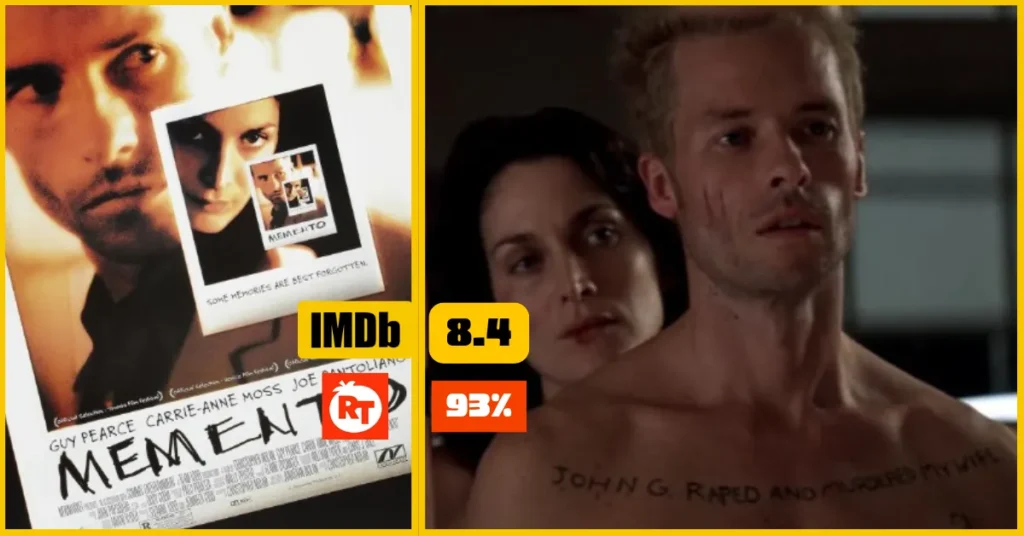
Memento Ending Explained: Who Is John G. and What Really Happened?
Memento(2000) is a neo‑noir psychological thriller where a man with damaged memory hunts for his wife’s killer using tattoos and Polaroids as his only reliable notes. This article offers a completeMemento movie explainedandMemento ending explainedbreakdown, focusing on the twisty structure, character motives, and what the final reveal really means.Mementois one ofChristopher Nolan’smost influential films, and understanding how the story is told backwards is the key to understanding Leonard’s truth.
Overview
Mementois a dark, puzzle‑boxthriller moviewith strongmysteryandneo‑noirelements, running about 113 minutes. It followsLeonard Shelby, played byGuy Pearce, who suffers from anterograde amnesia and cannot form new short‑term memories after a head injury during a home invasion.
The movie’s signature trick is its dual‑timeline structure: color scenes move backwards while black‑and‑white scenes move forward until they merge in the climax. The mood is tense, paranoid, and melancholic, with Nolan’s grounded approach to memory, identity, and self‑deception driving every choice.
Spoiler Warning
⚠️SPOILER ALERT – FULL MEMENTO EXPLAINED
From this point on, the article goes deep into plot twists, character deaths, and theMemento ending explained.
If you haven’t seen themovieyet, pause here, watch it on your preferredOTT platform, and then come back.
Story Explained (Full Breakdown)

Act 1 explained – Leonard’s condition and system
The story opens with a killing in reverse: a Polaroid of a dead man fades back to blank, a bullet flies upward, and Leonard shootsTeddyin an abandoned building. Then the film rewinds time in color segments, each showing what happened just before the previous scene, mirroring Leonard’s broken memory.
We learn Leonard used to be an insurance investigator who now suffers from anterograde amnesia after being struck on the head during an attack where his wife was assaulted and (he believes) killed. To cope, he builds a rigid system:
- Polaroid photos labelled with notes (“Don’t believe his lies”).
- Handwritten reminders.
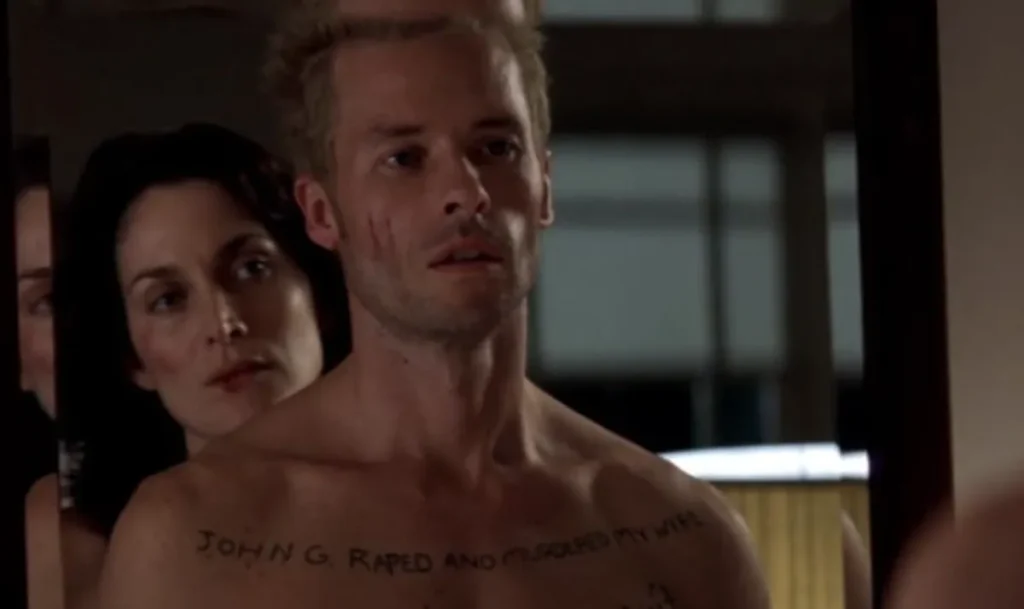
- Permanent tattoos on his body with key facts like the license plate, “John G” name, and “Remember Sammy Jankis.”
Parallel black‑and‑white scenes show Leonard in a motel room narrating his condition and telling the story ofSammy Jankis, another man with memory problems whom Leonard once investigated. Sammy becomes Leonard’s mental case study for what is and isn’t fake about his own condition.
Act 2 explained – Natalie, Teddy and manipulation
As the color scenes move backward, Leonard meetsNatalie(Carrie‑Anne Moss), a bartender with her own agenda. She initially appears sympathetic, offering help and information about a man namedDodd, but it quickly becomes clear she learns how to weaponize Leonard’s condition.
In one brutal sequence, she verbally abuses Leonard’s dead wife, then leaves the room knowing he will forget the argument within minutes; when Leonard loses the memory, she returns pretending he was beaten by someone else so she can manipulate him into attacking Dodd for her. Leonard’s fragile system is exposed as easily hackable because he trusts his own handwriting and Polaroids more than any living person’s word.
Meanwhile,Teddy(Joe Pantoliano) hangs around as a suspicious, talkative man claiming to be helping Leonard track down the real “John G.” Leonard’s Polaroid of Teddy has the ominous note “Don’t believe his lies,” setting up a constant tension: is Teddy a corrupt cop using Leonard, or the only one telling the truth?
Act 3 explained – John G., Sammy, and the truth
As the black‑and‑white timeline moves forward and the color timeline moves backward, they eventually meet in the middle at an abandoned building where Leonard confrontsJimmy Grantz, Natalie’s boyfriend. Leonard, following his tattoos and notes, believes Jimmy may be the “John G.” he is hunting.
Leonard kills Jimmy, takes his clothes, and hears Jimmy gasp “Sammy…” as he dies, which rattles Leonard’s belief system. This moment triggers Teddy to reveal the film’s core twist: Leonard has already killed the real attacker long ago, and this entire “case” is a loop that Leonard keeps repeating because he cannot live without a mission. Teddy claims Leonard’s memory has erased the actual resolution, so he keeps reinventing a new “John G.” and a new hunt.
Key Themes Explained
One key theme ofMementoisthe fragility of memory: the movie suggests that memories are not objective recordings but stories people choose to believe. Leonard insists that “facts, not memories” matter, yet his tattoos, notes, and Polaroids are themselves biased choices that he can edit, misread, or plant with lies.
Another major theme isself‑deception. Leonard’s condition gives him an excuse to rewrite his life every fifteen minutes, but the ending reveals he consciously chooses to mislead his future self, preferring a comforting lie over a painful truth. The film also exploresidentity: if you cannot form new memories, are you the same person from one moment to the next, or just a series of disconnected versions of yourself?
Finally,Mementoplays withrevenge and purpose. Leonard’s vengeance quest gives structure to his existence, and the movie suggests that sometimes people cling to revenge not for justice, but to avoid facing an empty life without it.
Characters Explained
- Leonard Shelby (Guy Pearce)
Leonard is a former insurance investigator whose entire identity is built around avenging his wife. His motives seem pure—seeking justice—but his behaviour reveals a man desperate for purpose, even if it means lying to himself and turning his body into a map of half‑truths. - Natalie (Carrie‑Anne Moss)
Natalie is a bartender connected to the drug world through her boyfriend Jimmy, and she quickly realizes Leonard can be used as a weapon. She swings between moments of apparent kindness and cold manipulation, representing how easily people can exploit someone vulnerable who believes their “system” makes them safe. - Teddy (Joe Pantoliano)
Teddy is a shady figure claiming to be a cop who originally helped Leonard track down the real attacker. His motives are messy—he benefits from using Leonard for side jobs—but his big confession suggests he may be the only one confronting Leonard with an ugly truth that Leonard refuses to accept. - Sammy Jankis (Stephen Tobolowsky)
Sammy is introduced as a man with a similar condition who ultimately caused his wife’s death through repeated insulin injections she hoped would prove whether his problem was real or psychological. By the end, the film hints that parts of Sammy’s story might actually be Leonard’s own past, showing how he offloads guilt into a “case study.”
Twist Explained
The central twist is thatLeonard has already completed his revenge before the main plot even begins, but because of his memory condition and his need for purpose, he resets the hunt. Teddy reveals that Leonard killed the real second attacker long ago, and that Teddy has been using Leonard’s skills to take down other criminals by tagging them as new “John G.” targets.
Leonard’s system, which he treats as objective truth, is shown to be deeply subjective. In a conscious act of self‑deception, Leonard writes down Teddy’s license plate as a clue and tattoos it on himself, deliberately framing Teddy as the next “John G.” even though he knows Teddy’s version might be true. This means the mystery is not “Who killed Leonard’s wife?” but “How far will Leonard go to avoid living without a revenge narrative?”
Memento Ending Explained
What exactly happens in the ending?
In the chronological “end”—which the film positions at the intersection of the black‑and‑white and color timelines—Leonard kills Jimmy in the abandoned building, believing he has finally found his wife’s killer. Teddy arrives and explains that Jimmy was just another criminal Leonard was manipulated into killing, and that Leonard had already killed the real attacker a long time ago.
Teddy reveals that Leonard’s wife actually survived the original assault and later died due to Leonard’s condition, strongly implying the Sammy Jankis insulin story is really Leonard’s own hidden memory. Faced with this unbearable truth, Leonard makes a devastating choice: he decides to create a new “John G.” target by writing down Teddy’s license plate and leaving himself notes that will inevitably lead to Teddy’s death.
In the opening scene (chronologically the last event), Leonard kills Teddy, fully believing the lies he planted for his future self. The audience realizes Leonard’s quest is a closed loop: he will never escape the cycle because he keeps choosing the story that gives him purpose.
What the ending means
TheMemento ending explainedin simple terms: Leonard chooses illusion over truth. He realizes that knowing he already avenged his wife would leave his life empty, so he weaponizes his memory condition to keep himself locked in a revenge loop. The final voiceover captures this tragedy: Leonard says he has to believe in a world outside his own mind, even as he manufactures that “world” with tattoos and Polaroids.
The ending ties back to the theme ofself‑authored narratives. Everyone tells themselves stories to live, but Leonard’s condition makes his storytelling literal and deadly. His body becomes both diary and prison, filled with facts that may be true in isolation but arranged to support a lie he wants to believe.
Alternate interpretations
Some viewers read Teddy’s confession as partially unreliable, suggesting he might twist facts to protect himself while still exploiting Leonard. In this angle, Leonard’s choice to target Teddy can be seen not only as self‑deception, but also as a rebellion against someone who has abused him.
Another interpretation questions the reality of the Sammy Jankis flashbacks, seeing them as a blend of real case file and Leonard’s suppressed memories. Whether or not Teddy is fully honest, the film makes one point clear: Leonard actively participates in shaping his own reality, even when that reality destroys others.
Performances
Guy Pearcedelivers a tightly coiled, vulnerable performance as Leonard, balancing toughness with a sense of constant confusion. The way he repeats lines, scans his tattoos, and clings to Polaroids sells both the clinical side of his condition and the emotional toll it takes.
Carrie‑Anne Mossgives Natalie sharp edges and unpredictability, shifting from sympathetic to cruel in seconds, especially in the living‑room scene where she verbally dismantles Leonard knowing he will forget.Joe Pantoliano’s Teddy is slippery and oddly charming, which makes his big exposition scene feel less like a “villain monologue” and more like a bitter, frustrated attempt to break through Leonard’s denial.
Direction & Visuals
DirectorChristopher Nolanand cinematographerWally Pfisteruse color and black‑and‑white to make the fractured structure readable and thematic. The color scenes running backward keep viewers in the same disoriented state as Leonard, while the forward‑moving black‑and‑white scenes act as a spine that grounds the timeline.
The visual style leans intoneo‑noiraesthetics: stark motel rooms, harsh lighting, and a muted color palette that suggests decay and moral ambiguity. Close‑ups of tattoos and Polaroids turn Leonard’s body and objects into narrative devices, letting the camera linger on words that eventually betray him.
Pros and Cons
Pros
- Clever non‑linear structure that mirrors Leonard’s memory, making the audience feel his confusion in a controlled way.
- Strong performances byGuy Pearce,Carrie‑Anne Moss, andJoe Pantoliano, who keep morally grey characters compelling.
- Thematically rich exploration of memory, identity, and self‑deception that rewards rewatching.
Cons
- The backward structure can be frustrating for viewers who prefer straightforward narratives.
- Heavy exposition in Teddy’s final speech may feel dense or ambiguous, leaving some audience members unsure what to believe.
- Emotional connection to the wife is limited on screen, since she mostly appears in fragments and flashbacks.
Cast
Crew
Who Should Watch?
Mementois ideal for viewers who enjoymind‑bending thrillers, puzzle narratives, and character‑driven mysteries. Fans ofChristopher Nolan, twisty storytelling, or morally complex protagonists will find a lot to unpack here.
If you like movies such asMulholland DriveorFight Club, thisOTTstaple should be high on your watchlist.
Verdict
As amovie,Mementoremains one of the most influential thrillers of the 2000s, showing how structure can become theme without turning into a gimmick. The film’s fractured timeline, grounded performances, and bleak sense of humor create a gripping, rewatchable experience that still feels fresh on modernstreaming platforms.
From aMemento movie explainedperspective, the real sting is not the revelation of who “John G.” is, but the realization that Leonard chooses to live inside a lie he designs himself. That choice makes theMemento ending explainednot just clever, but haunting—and it is why the film sticks with audiences long after the credits roll.
Reviews & Rankings
Critically,Mementoholds a high approval rating, sitting above 90% onRotten Tomatoesand scoring in the mid‑8s onIMDb, reflecting strong critical and audience reception. It is often ranked among the top psychological thrillers of its decade and widely cited as the breakout that establishedChristopher Nolanas a major director.
| Source | Score / Comment (approx.) |
|---|---|
| IMDb | Around 8.4/10 user rating. |
| Rotten Tomatoes | Low‑90s% Tomatometer, strong acclaim. |
| General consensus | Complex but rewarding thriller; must‑watch for Nolan fans. |
Where to Watch
Availability changes by region, butMementohas been available onAmazon Prime Videoin several countries and on platforms likePeacockand free ad‑supported services such as Pluto TV. In India, listings have includedJioCinemaand other services at different times, so checking a regional aggregator like JustWatch or yourOTTapp’s search is recommended.
If you are planning a “rewatch with notes” session, watching on a platform that allows easy pausing and rewinding will make theMemento ending explainedand timeline connections much easier to follow.