
🎬 Lights Out
Release Year: 2016
Streaming Platform: MAX, Netflix (varies by region)
⭐ IMDb: 6.3/10 | 🍅 Rotten Tomatoes: 76%
1. Lights Out Explained: Movie Plot Breakdown & Shocking Ending Analysis
Are you afraid of the dark?Lights Out, the 2016 breakout horror hit, takes that universal childhood fear and weaponizes it into a relentless, emotionally charged nightmare. Based on directorDavid F. Sandberg’s own viral short film, this feature-length expansion is more than just a series of jump scares. It’s a story about familial trauma, mental illness, and the shadows we can’t outrun.
This“Lights Out” movie explainedguide will walk you through the entire plot, dissect its key themes, and provide a deep dive into its shocking, tragicending explainedsection. If the fate of the family and the true nature of the monster Diana left you with questions, you’ve come to the right place.
2. Overview
Lights Outis a supernatural horror film that masterfully blends classic haunted house tropes with a poignant family drama. The mood is persistently tense, using darkness not just as a setting but as the primary antagonist. With a tight runtime of 81 minutes, it’s a lean, efficient scare machine that gets straight to the point. At its core, the film explores themes of depression, grief, and the devastating impact of untreated mental illness on a family unit. It’s a film where the monster in the dark is horrifying, but the real-world problems in the light are just as terrifying.
3.SPOILER WARNING
The following sections contain full spoilers for Lights Out, including major plot points and the ending. Proceed with caution if you haven’t seen the film.
4. Story Explained (Full Breakdown)
Act 1 Explained
The movie opens with Paul, an employee at a textile factory, working late. He sees a silhouette of a woman materialize in the dark, vanishing when the lights are on. This entity, Diana, kills him when he flips the switch, establishing the core rule: she exists and is lethal only in darkness. We then meet Rebecca, Paul’s step-daughter, who lives independently and is still haunted by her childhood, marked by her mother Sophie’s erratic behavior and whispers to the dark.
Rebecca’s younger half-brother, Martin, is now experiencing the same terror. He’s falling asleep in school because he’s afraid to sleep at home, where his mother Sophie talks to someone named Diana in the shadows. Rebecca, feeling responsible, takes Martin to her apartment. But Diana’s power isn’t confined to one house. She manifests in Rebecca’s dark apartment, proving she is attached not to a place, but to their mother, Sophie.
Act 2 Explained
Rebecca, her boyfriend Bret, and Martin investigate. They discover Diana was a former patient at the mental hospital where Sophie was treated. Diana had a rare disease that made her lethally allergic to light. Experimental light therapy killed her, but her psychic connection to Sophie—formed during their treatment—remained. Diana is not a ghost in the traditional sense, but a manifestation of Sophie’s depression and trauma, given form and malicious intent. She thrives on Sophie’s instability.
The trio realizes that keeping lights on is only a temporary solution. Diana sabotages the power grid, plunging the city into darkness. They rush to save Sophie, who is completely under Diana’s influence. Diana sees Sophie as hers alone and views the children as threats to their “togetherness.” The battle moves to the family home, where light sources become precious weapons in a desperate survival game.
Act 3 Explained
In the climactic confrontation, Sophie is fully possessed by her need for Diana. She chooses the entity over her own children, turning off lights to allow Diana to attack. Rebecca and Martin fight back using UV lights, flashlights, and car headlights, managing to severely weaken Diana. However, they realize the terrible truth: Diana is sustained by Sophie’s mind. As long as Sophie is alive and connected to her depression, Diana will always return.
The film’s heartbreaking resolution comes from Martin. To save his sister and finally free his mother from torment, he turns off the safe light. He makes the ultimate sacrifice, inviting Diana to attack him. Sophie, in a final moment of maternal clarity, jumps in front of the entity to save her son. Diana attacks Sophie instead, and as Sophie dies, Diana—whose existence is tied to her—disintegrates into nothingness.
5. Key Themes Explained
Lights Outis a potent allegory fordepression and mental illness. Diana is the physical embodiment of Sophie’s depression: she lurks in the shadows (the hidden parts of the mind), saps energy, isolates Sophie from her loved ones, and ultimately becomes a destructive force the sufferer feels they cannot live without. The line “She’s my friend” is a tragic echo of how mental illness can be perceived as a twisted companion.
The film also exploresinherited trauma. Rebecca and Martin are victims of a terror they didn’t create. Rebecca’s defensive, independent nature and Martin’s anxiety are direct results of their mother’s illness. The cycle of fear continues until they are forced to confront the source head-on. Furthermore, it tackles the theme ofsacrificial love. The ending pivots on the ultimate sacrifice a mother makes for her child, breaking the cycle of darkness by embracing the final, permanent light.
6. Characters Explained
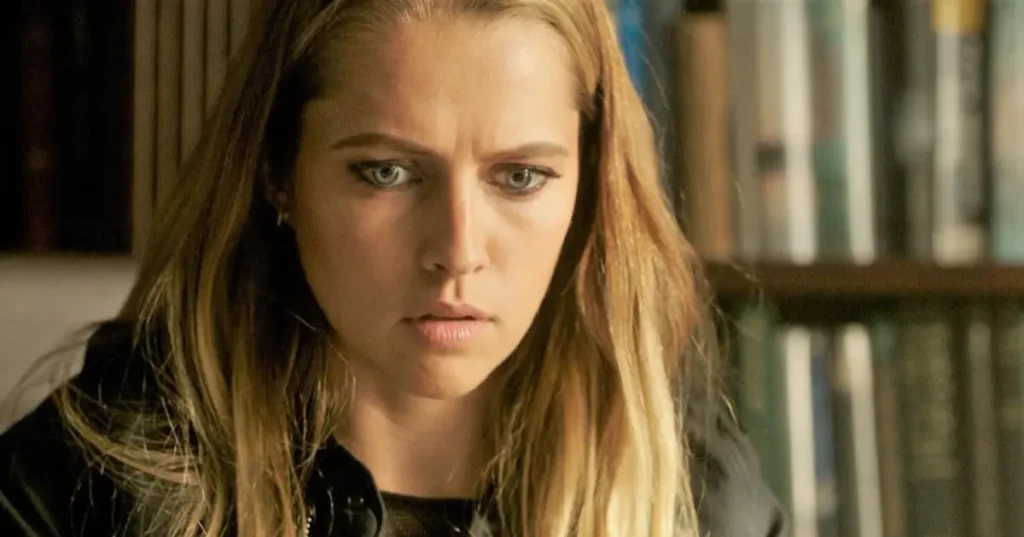
- Rebecca (Teresa Palmer):The resilient older sister burdened by the past. She initially runs from her family’s problems, but her love for Martin forces her to confront the childhood terror she escaped. Her arc is about taking responsibility and becoming the protector she never had.
- Martin (Gabriel Bateman):Represents innocence caught in the crossfire. His fear is palpable, but he also displays remarkable courage. His final, brave act to trigger the ending is a symbol of the younger generation forcing a resolution to a long-standing familial crisis.
- Sophie (Maria Bello):The tragic heart of the film. Sophie is a sympathetic figure, a woman consumed by grief and mental illness. Her love for her children is real but is utterly distorted and overridden by her pathological bond with Diana, which she mistakes for love and need.
- Diana (Alicia Vela-Bailey):More than a monster, Diana is a symptom. She is grief, depression, and trauma personified. Her physical design—emaciated, sharp, and fast—mirrors the predatory nature of these conditions. She represents the dark part of Sophie that refuses to heal.
7. Twist Explained
The film’s central twist isn’t a classic “whodunit” reveal, but apsychological and logistical one. The assumption is that Diana is a ghost haunting a house or a person. The twist is that Diana is neither. She is apsychic imprint, a tulpa born from the merged instability of two vulnerable minds in an institution. Her “rules” (vulnerability to light) stem from her real-life disease, but her existence is purely tied to Sophie’s psyche. This reframes the entire conflict: you can’t exorcise a memory, you can’t kill a thought with a flashlight. The only way to win is to sever the connection at its source, which leads to the film’s tragic conclusion.
8. Movie Ending Explained
What exactly happens?
In the final moments, Sophie sacrifices herself to save Martin from Diana’s killing blow. As Diana attacks Sophie, they both fall onto a sharp wooden post. Sophie dies from the impalement. Instantly, Diana, who is crouched over her, lets out a final shriek and vanishes into dust. The next morning, Rebecca, Bret, and Martin are shown in Rebecca’s sun-drenched apartment, alive but emotionally scarred. The final shot is of a family photo, now showing only Rebecca, Martin, and their late father Paul, with Sophie’s image faded away.
What the ending means and how it connects to the theme:
The ending is a brutal but necessary victory. Diana could only be destroyed by destroying her anchor—Sophie’s troubled mind. Sophie’s sacrifice is her first truly selfless act in years, a reclamation of her motherhood from the grip of her illness. By choosing her children over Diana, she finally breaks the connection. Her death is the “cure” for the supernatural disease plaguing her family.
Alternate interpretations:
Some viewers see a bleaker reading: that the cycle isn’t broken. The final shot of Sophie fading from the photo could imply her memory and trauma are being erased, but Rebecca and Martin are now permanently damaged. Could Rebecca’s own inherited struggles eventually manifest a new “Diana”? The sunny apartment feels peaceful, but the trauma they endured may simply be lurking in a new set of shadows.
Director’s intention:
David F. Sandbergcrafted the ending as a tragic but conclusive resolution. The intention was to show that some battles, especially against deep-seated mental illness, can have a devastating cost. The victory is survival for the children and peace for the mother, but it comes with the permanent loss of a parent. It’s a horror ending that prioritizes emotional resonance over a simple “they lived happily ever after.”
9. Performances
The film’s emotional weight rests on its cast.Maria Bellodelivers a heartbreaking performance as Sophie, perfectly balancing fragility, love, and terrifying instability. You believe her as a sick woman, not a villain.Teresa Palmergrounds the film as Rebecca, portraying gritty determination and vulnerability in equal measure. YoungGabriel Batemanis exceptionally convincing, selling sheer terror without becoming cloying. The physical performance ofAlicia Vela-Baileyas Diana is phenomenal, creating a monster that is both unnervingly still and shockingly fast.
10. Direction & Visuals
David F. Sandberg’s feature debut is a masterclass in economical, tension-driven horror. The visual language is simple but effective: warm, safe yellows versus cold, unsafe blues and blacks. The cinematography uses darkness as a tangible, suffocating presence. Scenes are often framed to maximize empty, threatening shadows. The sound design is crucial, with Diana’s clicking joints and heavy breathing making darkness an auditory experience. The film’s greatest achievement is making a well-lit room feel like a fortress and a single dying lightbulb feel like the most important object in the world.
11. Pros and Cons
Pros:
- A compelling, emotionally rich metaphor at its core.
- Efficient, relentless pacing with very effective jump scares.
- Strong, committed performances, especially from Maria Bello.
- Excellent use of a simple premise to create maximum tension.
- A memorable and tragic villain/monster.
Cons:
- Some character decisions feel contrived to serve the plot.
- The boyfriend character, Bret, while likeable, fits a standard horror archetype.
- The third-act lore dump about Diana’s origin, while necessary, slightly disrupts the atmospheric flow.
12. Cast
| Actor/Actress | Character | Notes |
|---|---|---|
| Teresa Palmer | Rebecca | The pragmatic older sister forced to confront her past. |
| Maria Bello | Sophie | The mentally ill mother haunted by a literal manifestation of her depression. |
| Gabriel Bateman | Martin | The young boy caught in a terrifying situation. |
| Alexander DiPersia | Bret | Rebecca’s loyal, if initially skeptical, boyfriend. |
| Alicia Vela-Bailey | Diana (Physical) | The performer behind the monster’s chilling movements. |
| Lotta Losten | Diana (Entity) | Also appears in a cameo, connecting to the original short film. |
13. Crew
| Role | Name | Notes |
|---|---|---|
| Director | David F. Sandberg | Expanded his own 2013 short film into a feature debut. |
| Writer | Eric Heisserer | Adapted the story from Sandberg’s short. Later wroteArrival. |
| Producers | Lawrence Grey, James Wan, Eric Heisserer | Wan’s (The Conjuring) involvement bolstered its horror pedigree. |
| Cinematographer | Marc Spicer | Created the stark, high-contrast visual style of light vs. dark. |
| Composer | Benjamin Wallfisch | Provided the haunting, atmospheric score. |
14. Who Should Watch?
Fans ofJames Wan-style horror (The Conjuring, Insidious) will find much to enjoy. It’s perfect for viewers who prefer horror with emotional stakes and a clear, powerful metaphor over gore or nihilism. If you’re fascinated by horror that explores mental health or simply want a tightly crafted, genuinely scary 80-minute thrill ride,Lights Outis for you.
15. Verdict
Lights Outis a standout modern horror film that proves a simple premise, executed with skill and heart, can be devastatingly effective. It transcends its “monster in the dark” setup by anchoring its terror in relatable familial trauma and the real-world specter of mental illness. Powered by strong performances and confident direction, it delivers scares that linger because they are rooted in character and emotion. The ending is a tragic punch to the gut that ensures the film is remembered long after the lights come back on.
16. Reviews & Rankings
| Source | Score | Verdict |
|---|---|---|
| Rotten Tomatoes | 76% Tomatometer | “Lights Outmakes skillful use of a simple yet effective premise, delivering a monster movie that manages to be both fun and frightening.” |
| IMDb | 6.3/10 (User Score) | Solid audience rating for a horror film, reflecting its popularity and effective scares. |
| Common Sense Media | 3/5 | Notes its intensity and strong horror elements, recommending it for older teens and adults. |
17. Where to Watch
Lights Outis available to stream onMAXin the United States. Availability on other platforms likeNetflixvaries by region. It is also available for digital rental or purchase on major platforms like Amazon Prime Video, Apple TV, and Google Play.
FAQs:
Lights Out
“When the lights go out, she comes out. A supernatural entity with a vendetta.”
Frequently Asked Questions
Get answers to the most common questions about the 2016 supernatural horror film “Lights Out”. Discover behind-the-scenes details, plot explanations, and more.
Released: 2016“Lights Out” is a supernatural horror film about a family haunted by a sinister entity that only appears in the darkness. When the lights go out, the entity named Diana becomes visible and attacks. The story follows Rebecca and her younger brother Martin as they try to uncover the truth about Diana’s connection to their mentally unstable mother, Sophie.
The film is based on David F. Sandberg’s 2013 short film of the same name and explores themes of mental illness, family trauma, and overcoming fears.
“Lights Out” was directed by David F. Sandberg, marking his feature film directorial debut. Sandberg originally gained attention with his 2013 short horror film of the same name, which went viral online and caught the attention of producer James Wan, who helped develop it into a feature film.
Sandberg went on to direct other horror films like “Annabelle: Creation” (2017) and “Shazam!” (2019), showing his versatility across horror and superhero genres.
The film features:
Teresa Palmer as Rebecca, the protective older sister trying to save her family.
Gabriel Bateman as Martin, Rebecca’s younger brother who is being targeted by Diana.
Maria Bello as Sophie, the mentally unstable mother with a connection to the entity.
Alicia Vela-Bailey as Diana, the supernatural entity (though she is mostly seen in silhouette).
Alexander DiPersia as Bret, Rebecca’s boyfriend who helps investigate the supernatural occurrences.
Diana was a troubled patient at the psychiatric hospital where Sophie worked. She suffered from a rare condition that made her extremely sensitive to light, causing severe burns when exposed. After undergoing experimental light therapy that went wrong and killed her, Diana’s spirit remained attached to Sophie.
Diana represents a toxic, possessive relationship, essentially becoming a supernatural manifestation of Sophie’s depression and mental illness. She only exists in darkness and seeks to isolate Sophie from everyone else, viewing others as threats to their “friendship.”
Director David F. Sandberg used mostly practical effects to create Diana. Actress Alicia Vela-Bailey performed the movements in a dark suit against black backgrounds, which was then enhanced with visual effects.
The distinctive jerky, unnatural movements were inspired by Sandberg’s wife Lotta Losten’s performance in the original short film. The effect of Diana appearing only in darkness was achieved through careful lighting and editing techniques that made her “disappear” when lights were turned on.
In the climax, Sophie sacrifices herself by turning off the emergency lights, allowing Diana to take her into the darkness so her children can live. The film ends with Rebecca, Martin, and Bret moving into a new home, but Diana’s entity appears to have followed them, suggesting the threat isn’t completely gone.
The ending symbolizes that while one can escape a specific situation, the underlying issues (represented by Diana) might still persist. It also leaves room for a potential sequel, though none has been made as of 2023.
“Lights Out” uses horror as a metaphor for depression and mental illness. Diana represents the dark, consuming aspects of mental health that isolate people from their loved ones. Sophie’s struggle with Diana mirrors real-world battles with depression where the condition convinces sufferers to push away those trying to help.
The film shows how mental illness affects not just the individual but their entire family. Rebecca’s frustration with her mother’s condition and Martin’s fear reflect the experiences of family members dealing with a loved one’s mental health struggles.
“Lights Out” was a major box office success considering its modest budget. Produced for just $4.9 million, the film grossed over $148 million worldwide, making it one of the most profitable horror films of 2016.
The film received generally positive reviews from critics, who praised its effective scares, strong performances (particularly Teresa Palmer’s), and thoughtful exploration of mental health themes within the horror framework. It holds a 74% approval rating on Rotten Tomatoes.
While “Lights Out” is not officially part of James Wan’s Conjuring Universe, it shares creative connections. James Wan served as a producer on the film, and director David F. Sandberg later directed “Annabelle: Creation,” which is part of The Conjuring Universe.
The film’s supernatural entity, Diana, operates under rules similar to those in The Conjuring films – she has a specific backstory, follows particular rules (only appearing in darkness), and forms an attachment to a vulnerable person. However, there are no direct crossover references between the franchises.
The 2013 short film “Lights Out” (just under 3 minutes long) became a viral sensation because of its simple but terrifying premise: a woman is stalked by a silhouette that only appears when the lights are off. The short effectively builds tension through alternating light and darkness, with the entity getting closer each time the lights go out.
Director David F. Sandberg made the short film with his wife Lotta Losten as the only actor, using minimal equipment. Its viral success demonstrated how effective horror can be with a simple concept executed well, leading to the feature film adaptation.