
🎬 Black Swan
Release Year: 2010
Streaming Platform: Disney+ / Hulu (varies by region)
⭐ IMDb: 8.0/10 | 🍅 Rotten Tomatoes: 85%
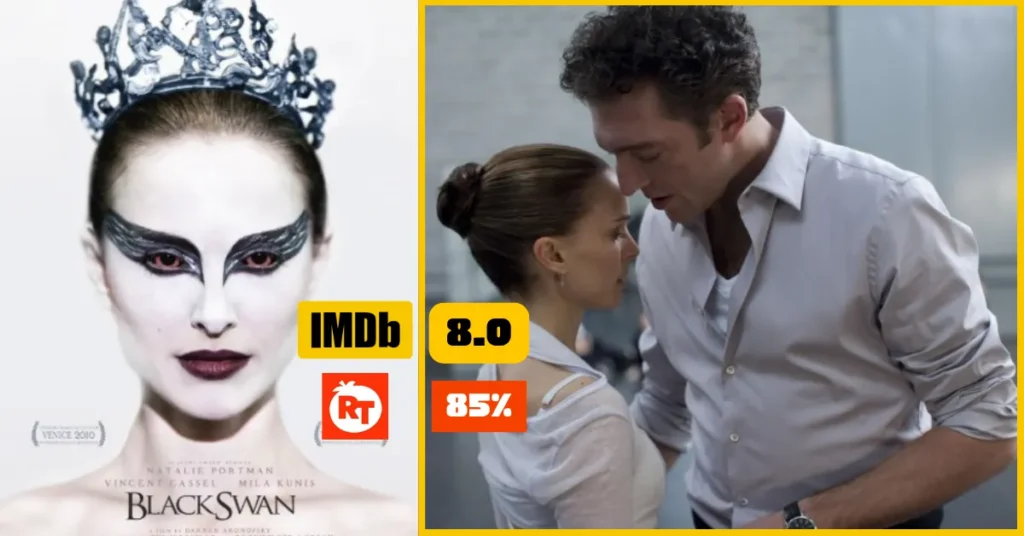
Black Swan is a psychological horror‑thriller about obsession, artistic sacrifice, and the terrifying cost of chasing perfection in the world of professional ballet. In this Black Swan Ending Explained breakdown, the focus is on Nina’s mental collapse, the film’s blurred reality, and what the final performance truly represents for her character arc.
Directed byDarren Aronofsky, themoviefollows ballerinaNina Sayers, played byNatalie Portman, as she prepares for a high‑pressure New York production of Swan Lake. This article will cover Black Swan Movie Explained in full: story breakdown, themes, key characters, the twist, and a detailed ending explanation that connects the final scene to the film’s larger ideas.
Overview
Black Swan is a dark psychological drama and mystery‑thriller set inside a prestigious New York City ballet company. The mood is tense, claustrophobic, and paranoid, mixing elegant dance with body horror and hallucination as Nina’s mind begins to fracture.
Themovieruns about 1 hour 48 minutes and follows Nina’s journey from repressed, fragile dancer to a dangerous embodiment of the Black Swan persona. Themes of duality, control, sexuality, and perfectionism run through every scene, making it less a simple dance film and more a descent into madness.
Spoiler Warning
⚠️SPOILER ALERT – BLACK SWAN ENDING EXPLAINED
From this point, there will be full spoilers for the entire Black Swan movie, including the twist and the final scene. If you have not watched theott movieyet, consider bookmarking this page and returning after you finish the film.
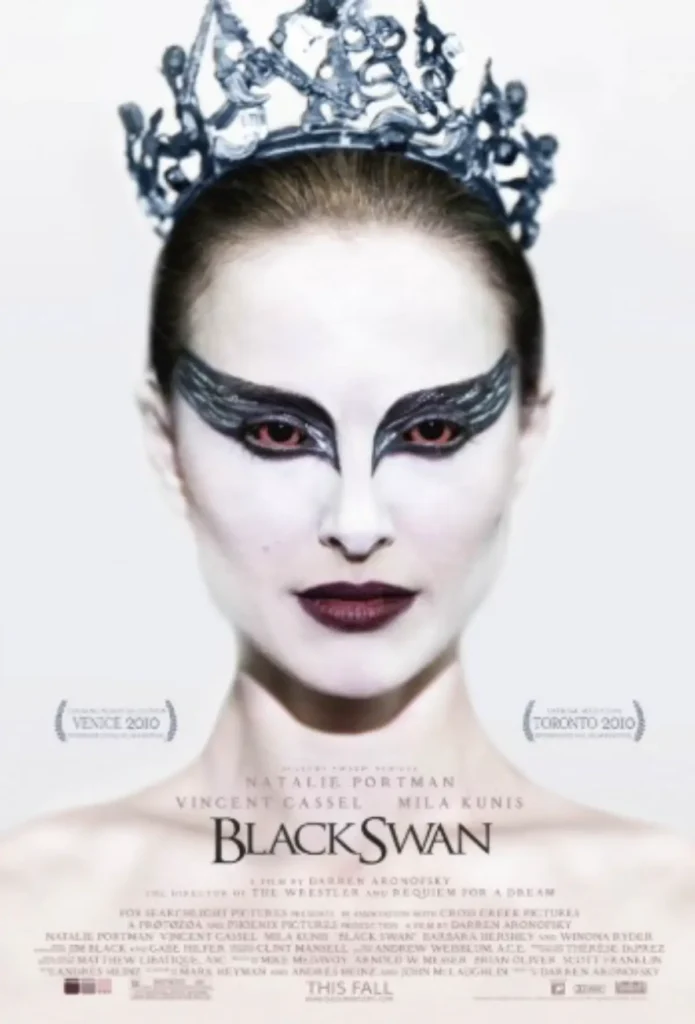
Story Explained (Full Breakdown)
Act 1 explained – The White Swan
At the start, Nina is a disciplined but emotionally fragile ballerina living with her controlling mother Erica, a former dancer who treats her like a child. She dreams of landing the dual role of the White Swan and Black Swan in artistic director Thomas Leroy’s new production of Swan Lake.
Nina perfectly captures the innocent, technically pure White Swan but struggles to embody the sensual, chaotic Black Swan that Thomas demands. A new dancer, Lily, arrives with a free, spontaneous style that threatens Nina’s position and triggers her insecurity.
Act 2 explained – Paranoia, Lily, and transformation
As rehearsals intensify, Nina’s body and mind start to rebel: she sees rashes, feathers, and distorted reflections, blurring the line between physical injury and hallucination. Thomas pushes her to “lose herself” and taps into her repressed sexuality, while Erica tightens control at home, infantilizing her with a pink, doll‑like bedroom.
Nina becomes obsessed with Lily as both rival and dark mirror, convinced that Lily wants to steal her role and sabotage her. During a wild night out, Nina drinks, takes drugs, and has a sexual encounter with Lily—though later it becomes unclear how much of it actually happened, signaling her fractured perception.
Act 3 explained – Opening night and collapse
On opening night, Nina’s paranoia peaks when she sees Lily preparing in the Black Swan costume and believes she has been replaced. In her dressing room, Nina confronts Lily, they fight, and Nina seemingly kills her by slamming her into a mirror and hiding the body—another moment that may only exist in Nina’s mind.
After this violent break, Nina performs the Black Swan with startling power, fully embracing a darker, more liberated self and seeing herself literally transform into a swan on stage. Returning to the dressing room for the final act, she realizes the “dead” Lily was an illusion, and the real wound is a piece of glass lodged in her own abdomen—yet she chooses to finish the show anyway.
Key Themes Explained
Black Swan is really about the destructive pursuit of perfection and how an artist can lose their identity in the process. Nina is so obsessed with being the “perfect” Swan Queen that she splits herself into the White (repressed, innocent) and Black (sexual, aggressive) halves and cannot reconcile them.
Control and repression are central themes: her mother, Thomas, and the ballet company all project expectations onto Nina until her inner self has no safe place to exist. Themovieuses body horror—skin tearing, nails, feathers—to show the psychological pain of molding one’s body and mind into an ideal.
Identity and duality also drive the story, with mirrors, doubles, and doppelgängers constantly reflecting alternate versions of Nina. The tension between purity and corruption, child and adult, victim and aggressor, all lead into the Black Swan Ending Explained as a kind of tragic self‑annihilation in the name of art.
Characters Explained
Nina Sayers
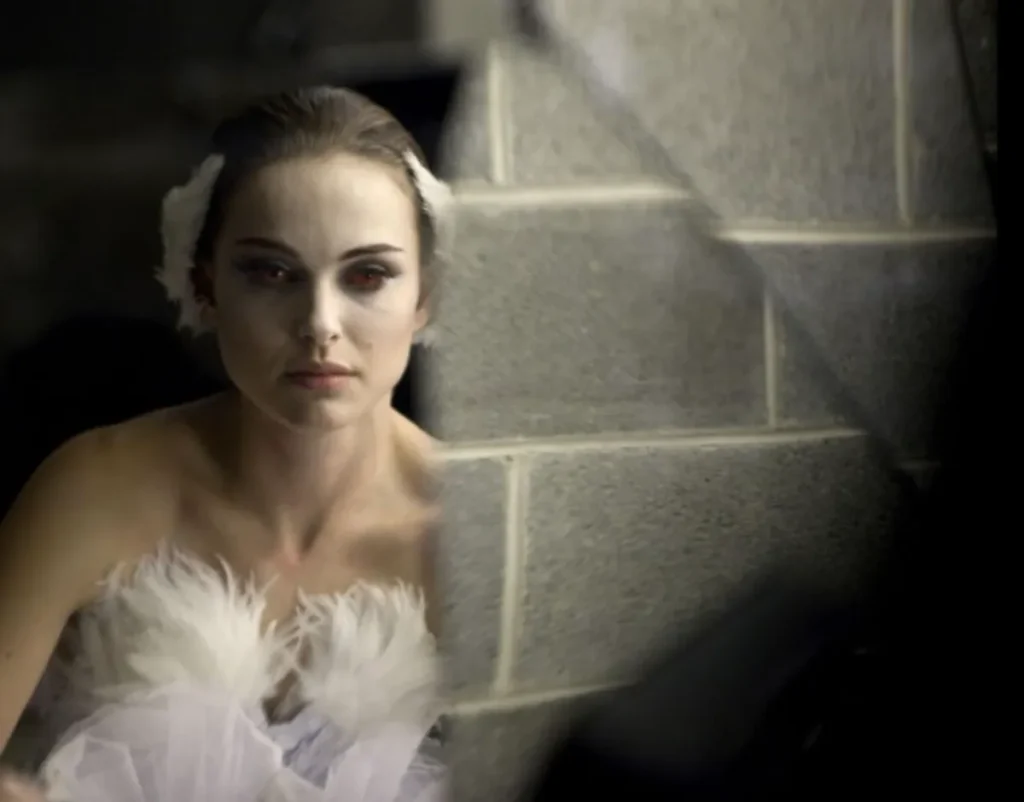
Natalie Portman’s character Nina is a sheltered, perfectionist ballerina who has never developed a stable adult identity outside dance. Her behavior is rigid, anxious, and self‑punishing; she is terrified of mistakes and deeply uncomfortable with her own sexuality.
As the film progresses, Nina’s suppressed desires and fears erupt as hallucinations, making her unable to distinguish reality from fantasy. By the end, Nina believes that truly becoming the Black Swan means destroying the “weak” version of herself, which feeds directly into the ending.
Lily
Mila Kunis’s Lily appears as Nina’s opposite: relaxed, sensual, and improvisational, everything Nina is told she lacks. On the surface she is a friendly colleague, but Nina’s paranoia turns Lily into a threatening double who might replace her.
Symbolically, Lily represents Nina’s shadow self—the free, reckless side she refuses to own. When Nina “fights” Lily in the dressing room, she is essentially battling and stabbing the part of herself she fears most, which becomes crucial to reading the ending.
Thomas Leroy
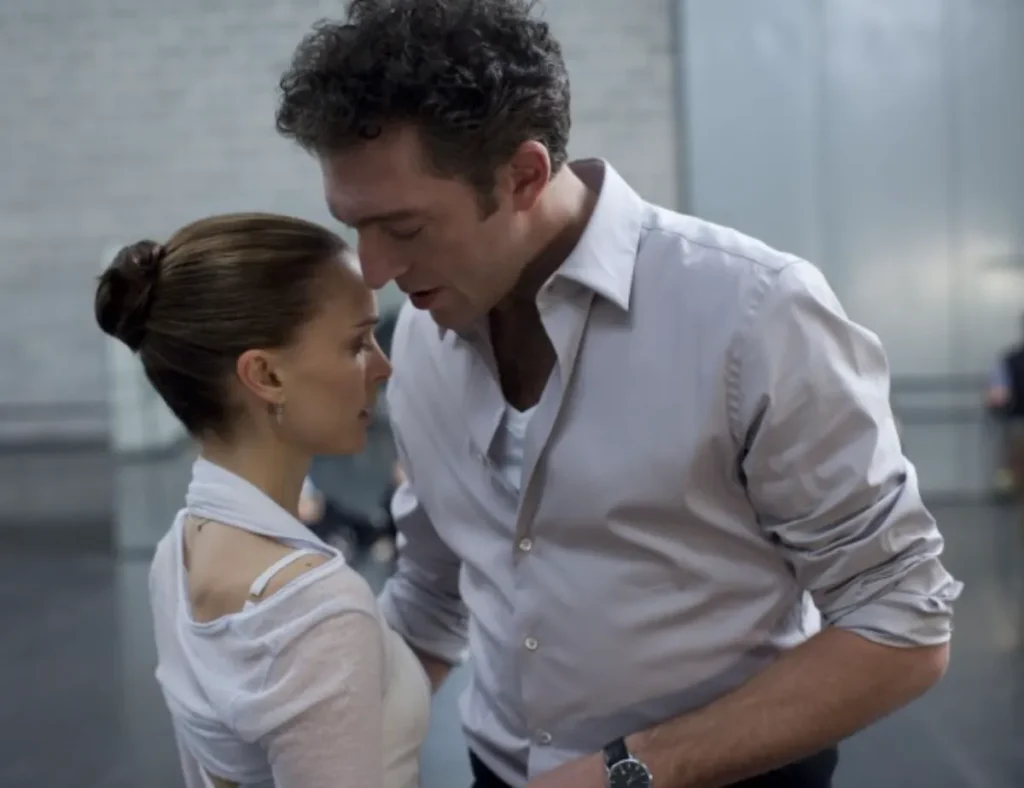
Artistic directorThomas Leroy, played byVincent Cassel, is manipulative but artistically demanding. He pushes Nina beyond technical perfection, insisting she must tap into chaos and sexuality to become the Black Swan.
Thomas uses seduction and humiliation as tools, blurring professional and personal boundaries to strip away Nina’s defenses. He functions as the corrupt mentor archetype, exploiting her vulnerability while also catalyzing her transformation.
Erica Sayers and Beth
Nina’s motherErica, portrayed byBarbara Hershey, is a former dancer who projects her failed career onto Nina and keeps her emotionally frozen as a child. She micromanages Nina’s life, watching her sleep, decorating her room with stuffed animals, and reacting violently when Nina tries to assert independence.
Beth, played byWinona Ryder, is the aging prima ballerina forced into retirement, a future version of Nina whose career has burned out. Beth’s self‑destructive behavior foreshadows what awaits Nina if she is consumed entirely by the company and the pursuit of perfection.
Twist Explained
The core “twist” of Black Swan is that many of the film’s most shocking moments are products of Nina’s deteriorating mind rather than objective events. The wild sexual encounter with Lily, the stabbing in the dressing room, and several body transformations are implied to be hallucinations or distorted memories.
Instead of one single twist reveal, themoviegradually shows how unreliable Nina’s viewpoint is, especially through mirrors and doubles. When Lily later appears alive and confused, it becomes clear that Nina has been fighting herself, not an external enemy, which re‑frames the final act as a psychological tragedy rather than a murder story.
Black Swan Ending Explained
What exactly happens in the ending
In the final act of Swan Lake, Nina performs the White Swan’s tragic death scene after her triumphant Black Swan performance. Before going back on stage, she notices blood spreading across her costume and realizes the glass shard she used during the “fight” is embedded in her abdomen.
Despite the injury, Nina chooses to complete the performance perfectly. She leaps off the set as the White Swan, lands out of view, and the audience erupts in applause. When Thomas and the other dancers rush to congratulate her, they see the blood and realize she is seriously wounded. Lying there, Nina whispers, “I was perfect,” as the screen washes out in white, suggesting her final breath.
What the ending means
On a literal level, Nina has critically injured herself and may be dying on stage as a result of her own delusion and obsession. On a symbolic level, the ending shows that Nina finally merges the White Swan and Black Swan within herself at a devastating cost.
By embracing risk, sexuality, and darkness, she delivers the performance Thomas wanted and the company demands. But because she connects artistic perfection with self‑destruction, she achieves transcendence only by sacrificing her body and possibly her life.
How it connects to the themes
The Black Swan Ending Explained makes the theme of destructive perfection completely explicit: Nina would rather die than live with an “imperfect” performance. Her last words, “I was perfect,” are not about happiness but about fulfilling an impossible standard imposed by others and internalized by herself.
The film’s recurring imagery of transformation—skin tearing, feathers, eyes changing—pays off here as Nina finally becomes the Swan Queen in her own mind. The white fade at the very end suggests a mix of stage light, spiritual release, and psychological oblivion.
Alternate interpretations
Some viewers read the ending as metaphorical, arguing that Nina may not literally die but experiences a kind of ego‑death where her old self is gone and a new, fractured identity remains. Others suggest she survives but will never mentally return to normal, effectively losing herself forever in the role.
Another angle is to see the entire film as a subjective fantasy constructed by Nina, with the final shot representing the moment when reality finally breaks under the weight of her delusions. In every version, though, the ending is not “happy” in a traditional sense; it is a tragic culmination of everything the story warned about.
Director’s intention (storytelling analysis)
Darren Aronofsky stages the ending like an operatic sacrifice, using close‑ups, swelling music, and the white fade‑out to emphasize Nina’s sense of transcendence. The film language leans toward a psychological reading: the camera hugs Nina’s perspective, making viewers feel trapped in her head until the very last frame.
By keeping the physical consequences ambiguous but emotionally overwhelming, the director invites debate instead of clear answers. The intention seems less about solving a puzzle and more about making audiences feel the seductive and horrifying power of total artistic commitment.
Performances
Natalie Portmandelivers a physically and emotionally intense performance that tracks Nina’s shift from fragile to feral. She convinces as both a technically precise ballerina and a woman unraveling under pressure, using small gestures—scratching, stiff posture, trembling—to show internal conflict.
Mila Kunisbrings looseness and charisma as Lily, making it easy to see why Nina would be both attracted to and threatened by her.Vincent Cassel’s Thomas walks a fine line between mentor and predator, using charm and cruelty to manipulate dancers in ways that feel disturbingly believable.
Barbara HersheyandWinona Ryderadd depth as the older generation of dancers: one clinging to her daughter, the other destroyed by retirement. Together, the cast makes themoviefeel grounded even when the hallucinations turn surreal.
Direction & Visuals
Aronofsky uses handheld, close‑quarters camerawork to keep viewers in step with Nina, often following her from behind through corridors and rehearsal spaces. This creates a suffocating, documentary‑like intimacy that heightens the anxiety and blurs the boundary between stage and reality.
The color palette contrasts soft pinks and whites in Nina’s home and costumes with darker blacks, grays, and deep reds as the Black Swan persona grows. Mirrors, reflections, and doubled images appear constantly, visually reinforcing the theme of duality and mental fragmentation.
Body‑horror elements—skin splitting, eyes reddening, feathers growing—are shot with disturbing detail, turning Nina’s transformation into a physical nightmare. Themovie’s visual style makes the psychological horror feel visceral, not abstract.
Pros and Cons
Pros
- Intense, committed lead performance byNatalie Portman, fully selling Nina’s psychological decline.
- Stylish, unsettling direction and visuals that fuse ballet elegance with horror imagery.
- Strong thematic focus on perfectionism, control, and identity that invites discussion and multiple interpretations.
Cons
- The constant tension and disturbing imagery can be overwhelming or triggering for sensitive viewers.
- Some may find the ambiguity of what is real versus hallucination frustrating rather than rewarding.
- Side characters outside the ballet world are lightly sketched, which can make the story feel narrowly focused on Nina’s inner turmoil.
Cast
Crew
Who Should Watch?
Black Swan is ideal for viewers who enjoy dark psychological thrillers, character‑driven horror, and intense performance‑focused cinema. Fans ofNatalie Portman,Darren Aronofsky, or stories about the dark side of art and ambition will likely find theott movieespecially gripping.
If you appreciate ambiguous endings, symbolic storytelling, and films like Requiem for a Dream or Perfect Blue, this is a must‑watch. However, those sensitive to body horror, self‑harm imagery, or anxiety‑inducing narratives should approach with caution.
Verdict
Black Swan remains one of the most striking psychological thrillers of the 2010s, combining ballet aesthetics with horror in a way that feels both beautiful and disturbing. The Black Swan Ending Explained shows how Nina’s quest for perfection becomes both her ultimate triumph and her destruction.
With a powerhouse lead performance, bold direction, and rich thematic layers, themovierewards rewatching and analysis long after the credits roll. For anyone searching specifically for Black Swan Movie Explained or trying to decode that haunting final shot, the film offers no easy comfort—only a chilling portrait of what it means to give everything to your art.
Reviews & Rankings
Black Swan holds an IMDb rating of about 8.0/10 from hundreds of thousands of users, reflecting strong audience appreciation. On Rotten Tomatoes, it sits around 85% with critics, indicating broadly positive reviews and praise for its intensity and style.
Where to Watch
Availability can change by region, but Black Swan is currently streaming on platforms such as Disney+ and Hulu in several markets. In India, streaming options may be limited or rotate, so checking localottguides or aggregators is recommended before watching.
Note:Details like ratings and streaming availability can change over time, so double‑check them on your preferred platform.