
🎬 Annabelle Comes Home
Release Year: 2019
Streaming Platform: MAX
⭐ IMDb: 5.9/10 | 🍅 Rotten Tomatoes: 64%
1. Annabelle Comes Home Movie Explained + The Ending Fully Analyzed

Welcome to our ultimate breakdown of the supernatural horror film,Annabelle Comes Home. This article serves as your completeMovie ExplainedandEnding Explainedguide to the third chapter in the Annabelle series, set squarely within the ever-expanding Conjuring Universe. Directed byGary Dauberman, the film cleverly shifts from a period-piece origin story to a classic, claustrophobic haunted house tale. We will walk through the entire plot, analyze its key themes, and most importantly, decipher the meaning and implications of its intense finale. Whether you just watched it and have questions, or are curious about the lore, thisMovie Explainedguide will shed light on the shadows of the Warrens’ most dangerous room.
2. Overview
Annabelle Comes Homeis a 2019 supernatural horror that acts as both a sequel toAnnabelle(2014) and a direct narrative bridge within the mainConjuringtimeline. The movie’s mood is one of sustained, creeping dread rather than constant jump-scares, relying heavily on atmosphere and the terrifying premise of a locked museum of evil. With a runtime of 106 minutes, it blends the familiar “babysitter in peril” trope with the unique twist of a house filled with dormant demonic artifacts. The central theme revolves around curiosity, grief, and the danger of unlocking doors—both literal and spiritual—that are meant to stay sealed.
3. SPOILER WARNING
4. Story Explained (Full Breakdown)
Act 1 Explained: Bringing Evil Home
The film opens in 1972, shortly after Ed and Lorraine Warren (played byPatrick WilsonandVera Farmiga) have taken the Annabelle doll from the nursing student nurses. They understand the doll is a conduit for a malicious spirit. In a tense sequence, they consecrate the doll in their car, highlighting its power. Despite their precautions, they decide the only safe place for it is the sacred artifact room in their home, where it is locked behind glass and blessed by a priest. The stage is set: Annabelle is now “home,” but contained.
We then jump to a year later. The Warrens are leaving for an overnight case, entrusting their young daughter Judy with a teenage babysitter, Mary Ellen. Mary Ellen’s friend, Daniela, arrives uninvited. Haunted by the recent death of her father, Daniela is desperate for any contact with the other side. She discovers the key to the artifact room and, despite explicit warnings, enters.
Act 2 Explained: Unleashing the Artifact Room
Daniela’s intrusion is the catalyst for chaos. By touching Annabelle’s case, she inadvertently “turns on” the doll’s demonic beacon. This act doesn’t just awaken Annabelle; it energizes every cursed object in the room. The protective seal is broken. What follows is a night of escalating terror as various entities are unleashed upon the house.
The Feeley Meeks ghost, a tormented spirit attached to a coin, appears. The Ferryman, a deadly specter with a coin-for-passage motif, begins his hunt. The haunted wedding dress, the spirit of a violent samurai armor, and other entities all become active. Annabelle herself acts as a puppeteer, rarely moving but orchestrating the horrors, using the other artifacts to torment and isolate the girls. The film becomes a race to survive until sunrise and, crucially, to re-contain Annabelle before her influence becomes irreversible.
Act 3 Explained: The Nightly Siege
The third act is a continuous siege. The entities separate the characters: Judy is targeted by a werewolf-like creature in her bedroom, Mary Ellen is haunted by the ghost of a grieving bride, and Daniela is psychologically tortured by manifestations related to her father’s death. They realize they must get Annabelle back into her case and re-establish the blessing.
Their attempts are fraught with peril. The Ferryman proves to be a relentless physical threat. Daniela, in a moment of clarity, understands she must let go of her guilt and need to communicate with her father to break the hold the evil has on her. The girls work together, using their wits and knowledge gleaned from the Warrens’ research to navigate the haunted house. The climax converges in the artifact room for one final, desperate stand.

5. Key Themes Explained
At its core,Annabelle Comes Homeis aboutcontainment vs. curiosity. The artifact room is a prison for evil, a concept that only works if the locks are respected. Daniela’s grief-driven curiosity shatters that containment, mirroring how personal, unresolved pain can open us up to negative influences.
The film also exploresgrief and guilt. Daniela isn’t a stereotypical reckless teen; she’s a traumatized one. Her need to speak to her father makes her vulnerable, and the demons exploit this very human weakness. The movie suggests that unresolved grief is an open door, one that malevolent forces are all too eager to walk through.
Finally, it touches oninherited legacy. Judy Warren, aware of her parents’ unusual work, lives with the constant weight of their calling. Her bravery in the face of the supernatural isn’t just about survival; it’s about stepping into the role she was born into, protecting others from the evil her parents have dedicated their lives to fighting.
6. Characters Explained
Judy Warren:More than just a victim, Judy is resilient and resourceful. She uses her knowledge of her parents’ work to guide the others. Her arc is about confronting fear and embracing her unique, if burdensome, inheritance.
Mary Ellen:The responsible babysitter who represents the “everywoman” thrust into an impossible situation. Her practicality and protectiveness towards Judy are her defining traits, and her skepticism is quickly replaced by a fierce will to survive.
Daniela:The emotional heart of the film. Her actions, while foolish, stem from profound sorrow and guilt over her father’s death. Her arc is one of catharsis—learning that true peace comes from letting go, not forcing a connection, even with the dead.
Annabelle/The Demon:Not a character in a traditional sense, but the central antagonist. It is a manipulative, patient evil that uses other spirits as its weapons. Its goal is simple: escape containment and claim souls.
7. Twist Explained
The film’s central “twist” isn’t a narrative shock but a conceptual one:Annabelle herself is the conductor, not the sole instrument. The audience might expect a movie about the doll moving and attacking. Instead, the twist is that Annabelle’s power is to activate the entire haunted museum. She is the battery that brings every other artifact to life. The real threat is the ensemble of spirits she unleashes, making the house itself a battlefield of multiple converging horrors. This reframes the Warrens’ artifact room not as a trophy case, but as a powder keg.

8. Movie Ending Explained
What exactly happens?
In the final moments, the girls manage to lure the Ferryman and other spirits. Mary Ellen and Daniela work together to get Annabelle back into her case. As the Ferryman closes in, Judy bravely reads the sacred blessing from her father’s notes, resealing the case just in time. The demonic entities vanish as Annabelle is re-contained. The Warrens return home at dawn to find the girls safe, but Lorraine immediately senses the traumatic energy of the night. The final shot is a slow push-in on Annabelle in her case, her eyes seemingly following the camera, confirming that the evil is dormant but never gone.
What the ending means & How it connects to the theme:
The ending reinforces the film’s core theme:containment is a constant, fragile battle. They won the night, but they didn’t destroy Annabelle. The evil is merely locked away again, a sleeping threat. This perfectly aligns with the real Warrens’ lore and the ongoing Conjuring Universe, where some evils cannot be destroyed, only managed.
Judy reading the blessing is highly symbolic. It represents thepassing of the torch. She uses her parents’ tools to save the day, showing that the fight against darkness will fall to the next generation. Daniela’s closure regarding her father shows that healing one’s own spirit is the best defense against external evil.
Director’s intention & Alternate angle:
Director Gary Daubermanhas stated he wanted a “haunted house movie” set within the Warren home. The ending is designed to feel like a temporary victory—a sigh of relief after a storm, but with the clouds still lingering on the horizon. An alternate interpretation is that the entire night served Annabelle’s purpose: to test the seals, to probe the weaknesses of those around her (especially Judy, the Warren heir), and to gather information for a future, more successful escape. Her persistent presence in the final shot suggests this was merely a skirmish in a long war.
9. Performances
Mckenna Graceis the standout as Judy Warren, delivering a performance that is both vulnerable and steel-spined. She conveys the weight of her character’s legacy without melodrama.Madison Iseman(Mary Ellen) provides a relatable anchor of fear and courage.Katie Sarife(Daniela) effectively portrays guilt and desperation, though the script sometimes limits her to a plot device. The cameos byVera FarmigaandPatrick Wilsonare brief but powerful, instantly grounding the film in the authentic, weary warmth of the Warrens.
10. Direction & Visuals
Gary Dauberman, in his directorial debut, shows a strong grasp of pacing and atmosphere. He builds tension through slow reveals and chilling sound design rather than gore. The cinematography by Michael Burgess uses warm, almost nostalgic ’70s lighting for the daytime scenes, which starkly contrasts with the cold, shadowy blues and blacks of the nighttime hauntings.
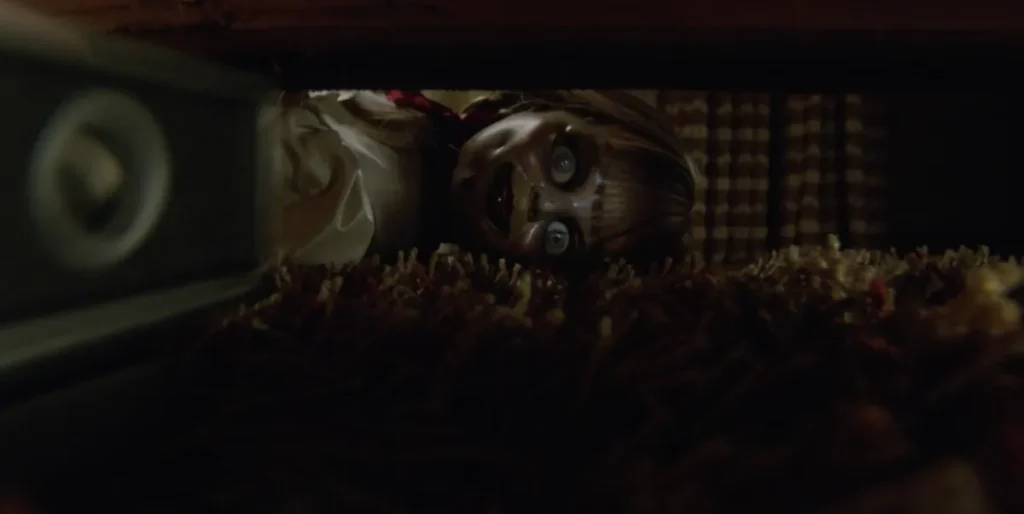
The visual symbolism is clear: the artifact room is a sacred/forbidden space, lit like a church reliquary gone wrong. The design of the other entities—the Ferryman’s muddy aesthetic, the Bride’s ethereal glow—creates a memorable gallery of ghouls. The camera often treats Annabelle like a sleeping monster, with careful, dread-filled compositions that emphasize her stationary yet dominant presence.
11. Pros and Cons
Pros:
- A fresh “haunted house” setup within established lore.
- Effective, creature-feature variety with multiple ghosts.
- Strong central performance from Mckenna Grace.
- Successful creation of a tense, claustrophobic atmosphere.
- Satisfying fan service that connects neatly to the larger universe.
Cons:
- Some character decisions feel frustratingly contrived.
- Daniela’s grief-motivation, while understandable, can feel repetitive.
- The plot is straightforward and lacks major narrative surprises.
- Underutilizes the iconic Warrens, despite their prominence in marketing.
12. Cast
| Actor | Character | Role |
|---|---|---|
| Mckenna Grace | Judy Warren | The Warrens’ psychically-sensitive daughter |
| Madison Iseman | Mary Ellen | The responsible teenage babysitter |
| Katie Sarife | Daniela Rios | Mary Ellen’s friend, grieving her father |
| Vera Farmiga | Lorraine Warren | Paranormal investigator, Judy’s mother |
| Patrick Wilson | Ed Warren | Paranormal investigator, Judy’s father |
| Michael Cimino | Bob Palmeri | Mary Ellen’s love interest |
| Samara Lee | Annabelle “Bee” Mullins | The ghost tied to the doll (flashback) |
| Stephen Blackehart | Feeley Meeks | Ghost attached to a cursed coin |
13. Crew
| Role | Name | Notable Work |
|---|---|---|
| Director | Gary Dauberman | It(writer),The Nun(writer) |
| Writer | Gary Dauberman | Annabelleseries writer |
| Producer | James Wan, Peter Safran | The ConjuringUniverse architects |
| Cinematographer | Michael Burgess | The Haunting of Hill House(TV) |
| Composer | Joseph Bishara | The Conjuring,Insidious |
14. Who Should Watch?
Fans ofThe Conjuring Universewho enjoy the connective lore will find this essential viewing. It’s perfect for viewers who prefer haunted house films with a variety of supernatural entities over slasher-style horror. Those new to the franchise can follow along easily, though prior knowledge enriches the experience.
15. Verdict
Annabelle Comes Homeis a solid, entertaining entry in the Conjuring franchise. It succeeds by narrowing its scope to a single terrifying night and expanding its horror palette beyond the central doll. While its characters and plot are occasionally thin, the film delivers effective scares, a great atmosphere, and meaningful development for the Warren legacy. As aMovie Explained, it’s a straightforward siege film, but itsEnding Explainedreminds us that in this universe, evil is never truly defeated—just waiting for the next lock to be picked.
16. Reviews & Rankings
| Source | Score | Verdict Snippet |
|---|---|---|
| IMDb | 5.9/10 | “A fun, if familiar, haunted house romp.” |
| Rotten Tomatoes | 64% | “A serviceable supernatural thriller…” |
| Common Sense Media | 3/5 | “Less intense than other Conjuring films.” |
| Audience Score (RT) | 59% | “Good for fans, but not the best in the series.” |
17. Where to Watch
Annabelle Comes Homeis available to stream onMAX. It is also available for digital rental or purchase on platforms like Amazon Prime Video, Apple TV, and Google Play Movies.
Ready to revisit the artifact room? StreamAnnabelle Comes Homeon MAX.
Annabelle Comes Home (2019) – Frequently Asked Questions
Annabelle Comes Home (2019) is the third film in the Annabelle series and the sixth installment in The Conjuring Universe. The story follows the Warren family’s teenage daughter Judy and her friends who accidentally unleash evil spirits from the family’s artifact room, including the possessed Annabelle doll, while Ed and Lorraine Warren are away on a case.
Key cast includes:
- Vera Farmiga as Lorraine Warren
- Patrick Wilson as Ed Warren
- McKenna Grace as Judy Warren
- Madison Iseman as Mary Ellen
- Katie Sarife as Daniela