
🎬 Parasite (2019)
Release Year: 2019
Streaming Platform: Hulu, Amazon Prime Video (Rent), Apple TV+
⭐ IMDb: 8.5/10 | 🍅 Rotten Tomatoes: 99%
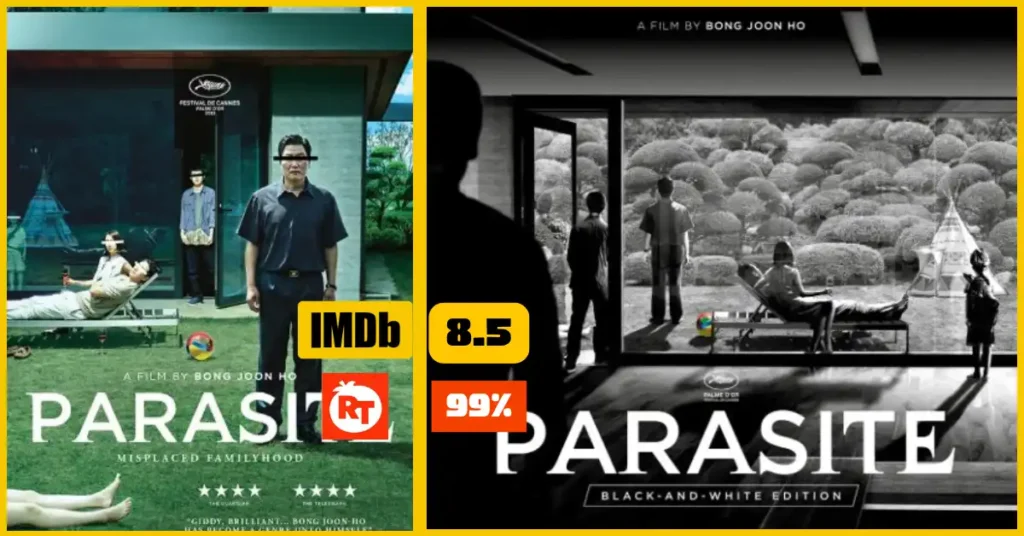
1. Parasite 2019 Explained: Unpacking the Symbols, Themes, and Shocking Finale
Bong Joon-ho’sParasiteisn’t just a movie; it’s a cultural event. It’s a genre-bending dark comedy thriller that made history as the first non-English language film to win the Academy Award for Best Picture. But beneath its slick surface and shocking twists lies a deeply layered story about class, inequality, and the smell of poverty. In thisParasite 2019 Movie Explainedarticle, we will guide you through the entire plot, break down the complex themes, and provide a detailedParasite ending explainedso you can fully appreciate this modern masterpiece.
2. Overview
Parasiteis a South Korean black comedy thriller directed by the visionarydirectorBong Joon-ho. Running for 132 minutes, the film masterfully blends multiple genres—shifting from family comedy to heist thriller to brutal horror—often within the same scene. At its core, it tells the story of two families: the impoverished Kims and the wealthy Parks. What starts as a con job by the Kims to secure employment in the Park household slowly unravels into a violent, chaotic exploration of the gap between the haves and the have-nots.
3. SPOILER WARNING
⚠️Spoiler Warning:The following sections contain major spoilers for the entire plot ofParasite, including the ending. If you haven’t seen the film yet, go watch it first—then come back to dive deeper.
4. Story Explained (Full Breakdown)
To understand the ending, you must first understand the intricate journey of the Kim family.
Act 1: The Infiltration
The Kim family—fatherKi-taek (Song Kang-ho), mother Chung-sook, son Ki-woo, and daughter Ki-jung—live in a cramped, semi-basement apartment, folding pizza boxes for a meager income. Their luck seems to change when Ki-woo’s friend gifts them a scholar’s rock and suggests Ki-woo take over his job tutoring Da-hye, the daughter of the wealthyPark family. Ki-woo, posing as a university student, gets the job. He quickly recommends his “sister,” “Jessica” (Ki-jung), as an art therapist for the Parks’ troubled young son, Da-song. Using manipulation and skill, Ki-jung frames the Park’s chauffeur, allowingKi-taek (Song Kang-ho)to take his place. Finally, the three conspire to expose the long-time housekeeper Moon-gwang’s (alleged) tuberculosis, and Chung-sook is hired as the new housekeeper. The plan is perfect; the Kims are now “employed” by the Parks, completely unknown to their wealthy employers.
Act 2: The Hidden Truth
While the Parks are away on a camping trip, the Kims indulge in the luxury of the modernist mansion, acting as if it is their own. Suddenly, the former housekeeper, Moon-gwang, rings the doorbell in the rain, begging to be let in to retrieve something from the basement. When Chung-sook lets her in, Moon-gwang descends a hidden staircase behind a bookshelf, revealing a secret underground bunker. Inside is her husband, Geun-sae, who has been secretly living there for years to evade loan sharks. The Kims’ cover is blown when they accidentally tumble down the stairs, revealing their familial connection. A tense, three-way standoff ensues, with both poor families fighting for their survival and their “job.”
Act 3: The Descent
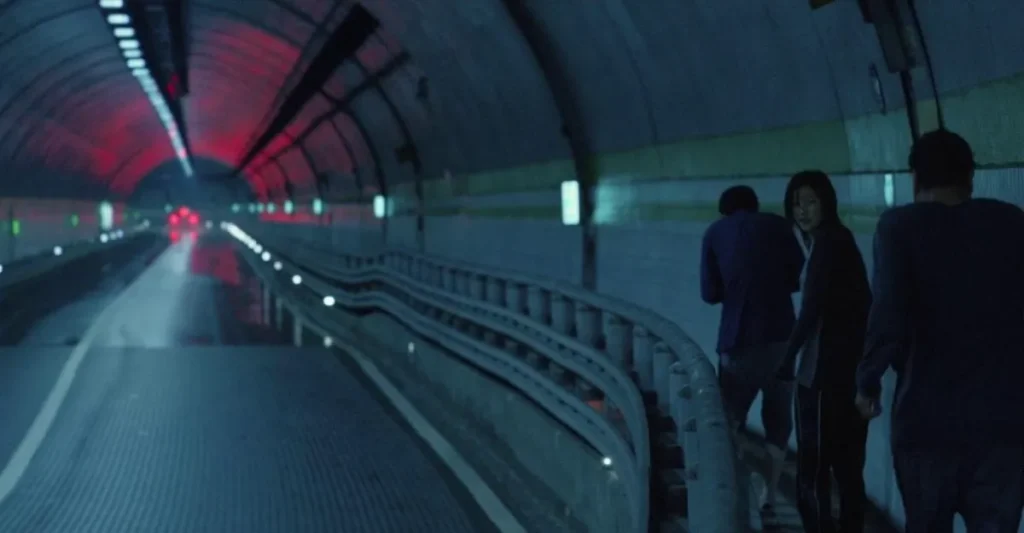
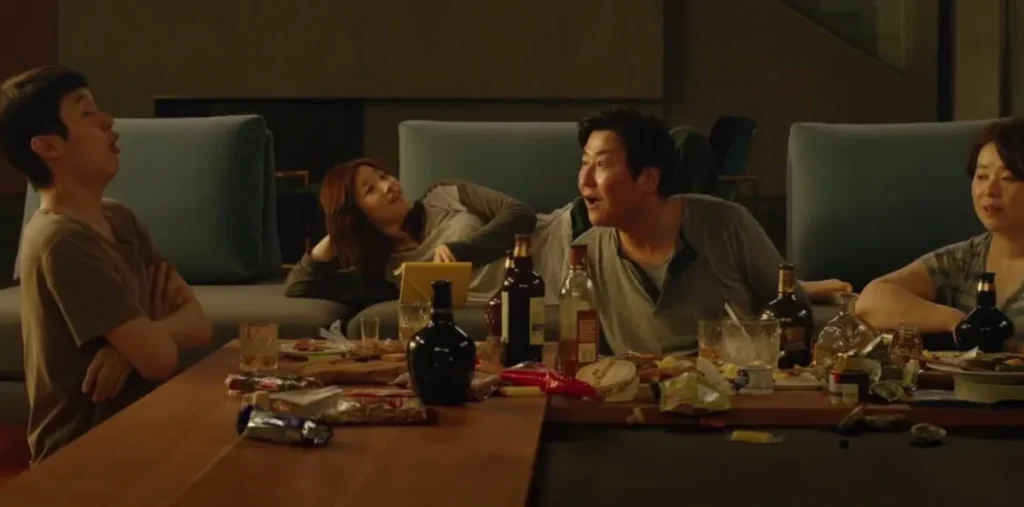
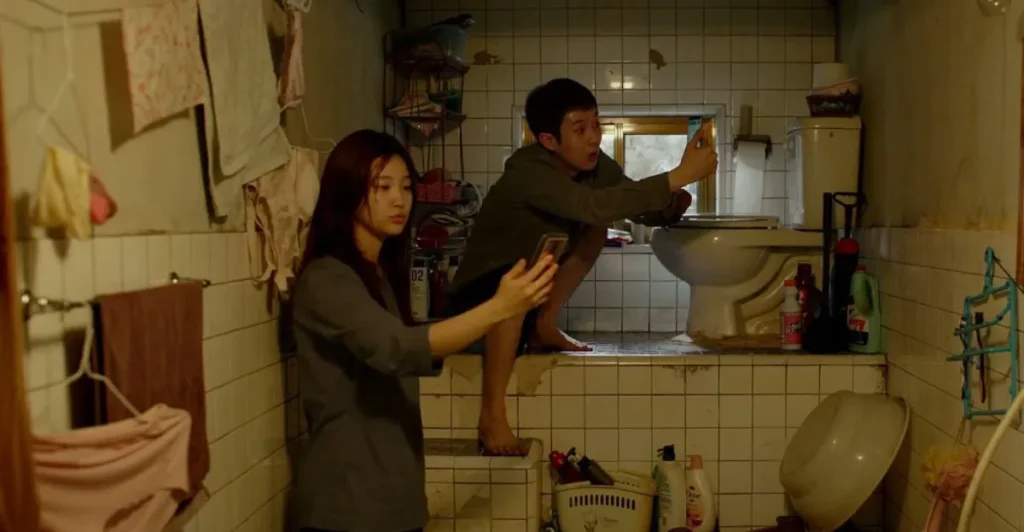
The Parks call to say they are returning early due to the rainstorm. The Kims manage to subdue Moon-gwang and Geun-sae, tying them up in the bunker, but the night goes from bad to worse. As the Kims hide under the coffee table in the living room, they overhear Mr. Park complaining about the smell of the poor—specifically, the smell of Ki-taek. This casual insult cuts deep. After the Parks fall asleep, the Kims escape into the torrential rain, only to return to their semi-basement home, which is now completely flooded. They lose everything. The next day, they are invited to the Park’s lavish garden party. Here, the film reaches its bloody climax: Ki-woo descends to the bunker to finish the fight but is bludgeoned by Geun-sae with the scholar’s rock. Geun-sae emerges from the basement, stabs Ki-jung, and is eventually killed by Chung-sook. In the chaos, as Mr. Park recoils from the smell of Geun-sae, Ki-taek, seeing the same disgust in his eyes, picks up a knife and fatally stabs Mr. Park before fleeing into the night.
5. Key Themes Explained
Parasiteis a rich text for analysis, using powerful metaphors to convey its message about capitalism.
- The Smell of Poverty:The most recurring theme is “smell.” Mr. Park describes Ki-taek’s odor as an old radish kimchi, a smell that “crosses the line.” It represents the intangible barrier between the classes. No matter how well the Kims dress or act, their fundamental social status is something they cannot wash off. It is a smell of the semi-basement, of struggle, and it ultimately triggers Ki-taek’s violent outburst.
- The Scholar’s Stone:The rock given to the Kims is meant to bring wealth. Initially, it seems to work, as they con their way into jobs. However, it is a false promise. In the end, the stone literally brings Ki-woo down, used as a weapon to bludgeon him. It symbolizes the crushing weight of aspirational wealth and the danger of believing in luck over structural change.
- Verticality and Space:DirectorBong Joon-houses physical space to define class. The Kims livedownin a semi-basement. The Parks liveupon a hill in a bright, open home. The ultimate poor, Geun-sae, lives even furtherdownin a dark, hidden bunker. The constant movement up and down stairs emphasizes that social mobility is a literal and exhausting climb.
6. Characters Explained
- Ki-taek (Song Kang-ho):The patriarch of the Kim family. He is proud but resigned to his fate. His transformation is the core of the film. He goes from a schemer to a witness of his family’s destruction, finally snapping not out of revenge for his family, but from the deep-seated shame triggered by Mr. Park’s disgust at Geun-sae’s smell—a smell he shares.
- Mr. Park (Lee Sun-kyun):Represents the “innocent” rich. He is not overtly cruel, but he is incredibly naive and classist. He only cares about his own comfort. His comments about smell are not made with malicious intent to hurt, but that casual ignorance is precisely what makes them so damning.
- Chung-sook (Jang Hye-jin):The practical and strong mother. She is the most grounded of the Kims. She is a skilled fighter and the one who ultimately kills Geun-sae. She represents the working class’s raw strength and resilience.
- Moon-gwang (Lee Jung-eun) & Geun-sae (Park Myung-hoon):The couple in the bunker. They are a dark mirror to the Kims. They are the “original parasites,” having found a way to survive, but their existence is even more desperate and dehumanizing. Their presence shows that there is always someone worse off, and that the poor will turn on each other to survive.
7. Twist Explained
The central twist ofParasiteis not just the existence of the bunker, but the revelation of who the “real” parasites are. The title initially suggests the Kim family are the parasites, feeding off the wealthy Parks. However,director Bong Joon-hohas explained that the title is deliberately ambiguous. The Parks are also parasites—they are completely helpless without the labor of the poor. They cannot drive, clean, or cook for themselves. They leech off the skills of people like the Kims just as much as the Kims leech off their money. The real parasite is the system of capitalism itself, which creates this cycle of dependency and contempt.
8. Movie Ending Explained
This is the most crucial section. The ending ofParasiteis haunting and open-ended, leaving audiences with a mix of hope and despair.
What Exactly Happens:
After the massacre at the party, Ki-woo wakes up from brain surgery weeks later. He and his mother are on probation for fraud. Ki-jung is dead. Ki-taek is missing, wanted for the murder of Mr. Park. One night, Ki-woo climbs the hill to the now-sold Park home. He sees a light flickering in the garden at night. He realizes it’s a Morse code signal from his father. The message reads: “I am here.” Ki-taek, having escaped the party, has gone down into the bunker. He now lives in the same darkness as Geun-sae, scavenging food from the new, unsuspecting German owners and signaling to his son every night.
In the film’s final scene, Ki-woo sits in his still-flooded semi-basement and writes a letter to his father. He imagines a future where he becomes incredibly wealthy, buys the house, and walks into the sunlight to greet his father as he emerges from the bunker. The film ends on a close-up of Ki-woo smiling at this dream, before cutting back to a shot of the letter, which he folds and places under a rock.
What the Ending Means:
The final scene is a devastating fantasy. It is not real. It is Ki-woo’s desperate hope, but the film has spent two hours proving that such social mobility is a myth.
- The Impossible Dream:For Ki-woo to buy that house, he would need to make an astronomical amount of money—the kind of wealth it would take several lifetimes for a poor Korean family to accumulate. The film tells us this is impossible.
- The Perpetual Descent:Ki-taek, who once lived in a semi-basement, has now descended into a complete, lightless bunker. He has become the ultimate parasite, literally living in the walls of the rich. He is a ghost, trapped forever.
- The Cycle Continues:Ki-woo and his mother are back where they started, in the semi-basement that flooded. They are in the exact same position, with even less hope. The ending suggests that there is no rising up. The poor can scheme, fight, and even kill, but the structure of society remains, pushing them back down.
Director’s Intention:
Bong Joon-ho confirms this interpretation. He has stated that the ending is essentially a “murder” and a “dream.” The son’s plan is so far-fetched it is absurd. By showing us this fantasy, the film forces us to confront the brutal reality: Ki-taek will likely die in that bunker, and the Kim family will never escape their basement.
9. Performances
The cast ofParasiteis flawless.
- Song Kang-hodelivers a career-best performance as Ki-taek. He portrays the character’s quiet desperation, humor, and eventual rage with subtle mastery. His eyes tell the entire story of a man broken by the system.
- Cho Yeo-jeongas the naive Mrs. Park is perfectly cast. She brings a lightness to the role that makes her ignorance feel authentic, not villainous.
- Park So-damas Ki-jung (“Jessica”) is the engine of the family’s schemes. Her energy and wit are captivating, making her tragic death all the more shocking.
- Lee Jung-eunas Moon-gwang is unforgettable. Her performance shifts from pathetic to terrifying to tragic within the span of a single scene in the bunker.
10. Direction & Visuals
Bong Joon-ho is a master of his craft, andParasiteis his magnum opus. The cinematography by Hong Kyung-pyo is a character in itself. The film usesensemble staging, placing multiple characters in a single frame to show their relationships and power dynamics. Notice how the Kims are often crouching or hiding in the Park house, visually placing them below their employers. The color palette is also meticulously chosen: the Park home is filled with warm, natural light and clean lines, while the Kim’s neighborhood is cluttered, gray, and dark. The use of the staircase as a visual motif—constantly moving up and down—is a brilliant way to represent the exhausting and futile attempt at social mobility.
11. Pros and Cons
Pros:
- Masterful Genre-Blending:The film seamlessly shifts from comedy to thriller to tragedy without missing a beat.
- Universal Themes:Its critique of inequality resonates with audiences worldwide.
- Rewatchability:The film is packed with foreshadowing and details that you only notice on a second viewing.
- The Ending:It is one of the most perfectly crafted, emotionally devastating endings in modern cinema.
Cons:
- Pacing for Some:The first half is lighter and more comedic, which might lead some viewers to underestimate the dark turn the film takes.
- Subtitles:As a Korean-language film, some viewers may be put off by subtitles (though dubs are available on some platforms).
12. Cast
| Actor | Character | Role in the Story |
|---|---|---|
| Song Kang-ho | Kim Ki-taek | Father of the Kim family; becomes the Parks’ chauffeur. |
| Lee Sun-kyun | Park Dong-ik | Father of the Park family; a wealthy IT CEO. |
| Cho Yeo-jeong | Choi Yeon-gyo | Mother of the Park family; naive and rich. |
| Choi Woo-shik | Kim Ki-woo (Kevin) | Son of the Kim family; becomes Da-hye’s English tutor. |
| Park So-dam | Kim Ki-jung (Jessica) | Daughter of the Kim family; becomes Da-song’s art therapist. |
| Jang Hye-jin | Park Chung-sook | Mother of the Kim family; becomes the new housekeeper. |
| Lee Jung-eun | Gook Moon-gwang | The original housekeeper of the Park family. |
| Park Myung-hoon | Oh Geun-sae | Moon-gwang’s husband, living in the secret bunker. |
13. Crew
| Role | Name |
|---|---|
| Director | Bong Joon-ho |
| Screenplay | Bong Joon-ho, Han Jin-won |
| Cinematography | Hong Kyung-pyo |
| Editing | Yang Jin-mo |
| Music | Jung Jae-il |
| Production Company | Barunson E&A |
14. Who Should Watch?
Parasiteis for anyone who loves cinema. It’s for fans of thrillers, dark comedies, and social dramas. If you enjoy films that make you think, that challenge your perspective, and that stay with you long after the credits roll, this is essential viewing. It is a film that rewards both casual viewers and hardcore cinephiles.
15. Verdict
Parasiteis not just a great film; it is a perfect one. It is a masterclass in storytelling, direction, and performance. Bong Joon-ho has crafted a thrilling, funny, and ultimately tragic fable about the dividing lines of our modern world. TheParasite ending explainedreveals a truth that is both heartbreaking and profound: in a world built on inequality, the only thing the poor can truly own is their dreams—and even those are likely to remain just out of reach.
16. Reviews & Rankings
Parasitereceived universal acclaim upon release.
- Rotten Tomatoes:99% Critic Score, 90% Audience Score.
- Metacritic:96/100 (Must-See designation).
- It was ranked number one on many critics’ lists for the best films of 2019 and the decade.
17. Where to Watch
You can streamParasiteonHuluwith a subscription. It is also available for digital rental or purchase on platforms likeAmazon Prime Video, Apple TV, and YouTube Movies. Check your local listings for theOTTplatform availability in your region.Watch it on Hulu, Prime Video, or Apple TV+.
FAQs:
🎬 PARASITE (2019) · FAQ
10 questions answered – class, twists & Bong Joon-ho