
🎬 Don’t Worry Darling
Release Year: 2022
Streaming Platform: Netflix / HBO Max
⭐ IMDb: 6.3/10 | 🍅 Rotten Tomatoes: 38%
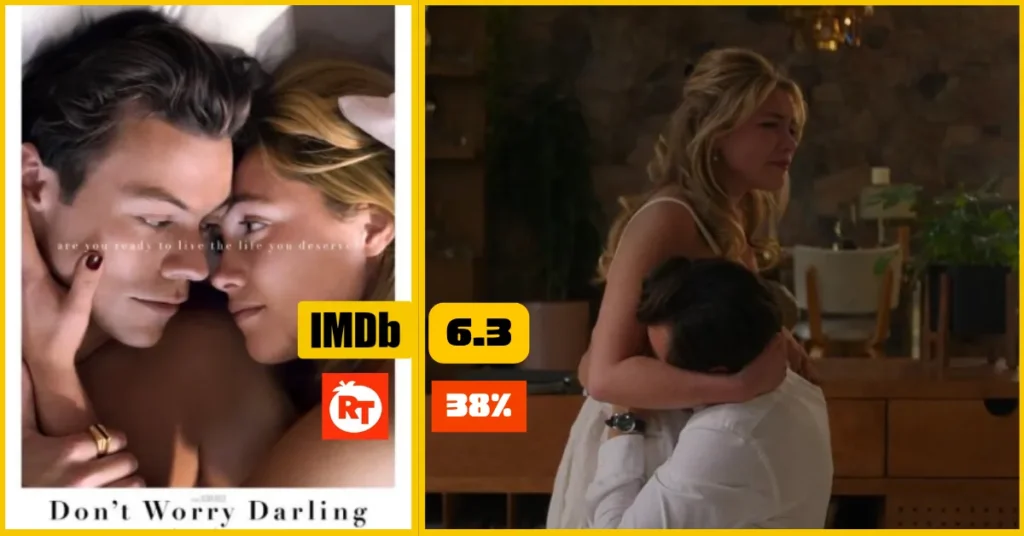
Don’t Worry Darling Movie Explained: Victory Town Secrets, Simulation Reveal & Final Escape
Don’t Worry Darling is a glossy psychological thriller that mixes 1950s suburban fantasy with Black Mirror–style sci‑fi horror.
This Don’t Worry Darling Movie Explained breakdown walks through the story act by act, unpacks the Victory Project twist, and offers a clear ending explained section with thematic and character analysis.
Overview
Don’t Worry Darling is a mystery‑drama/thriller about Alice, a perfect 1950s housewife living in an experimental desert community with her adoring husband Jack.
The movie runs about 2 hours (2h 3m) and leans heavily on mood, dread, and stylish visuals rather than jump scares, gradually turning its glamorous retro world into a psychological nightmare.
Spoiler Warning
⚠️SPOILER WARNING – DON’T WORRY DARLING MOVIE EXPLAINED
This article dives into the full plot, major twists, and the complete Don’t Worry Darling ending explained.
If you have not seen themovie, bookmark this and come back after watching.
Story Explained
Act 1 Explained – Life in Victory
At the start, Alice and Jack seem like the ideal couple in Victory, a closed, company-run town in the middle of the desert.
Men leave every morning to work on the mysterious Victory Project, while women cook, clean, shop, attend ballet, and enjoy cocktails, all under strict rules about never leaving the town’s borders.
The tone is dreamy and seductive: parties, synchronized routines, and glamorous 1950s fashion sell the fantasy that Victory is paradise.
But small cracks appear when Alice notices strange events, like a plane crash in the distance and her friend Margaret behaving erratically after questioning the town.
When Margaret publicly claims Victory is a lie and later appears to die in a shocking moment that is quickly covered up, Alice becomes the “difficult woman” who dares to ask what the Victory Project really is.
Act 2 Explained – Cracks in the Simulation
Alice starts having disturbing visions: mirrored images, suffocating walls, and surreal dances that feel like a glitch in reality.
She secretly follows a trolley to Victory’s headquarters in the desert, touches a strange mirrored building, and experiences a disorienting blackout that the town’s leaders insist was nothing.
The charismatic Victory leader Frank positions himself as a godlike figure, praising control, order, and loyalty while subtly warning Alice to fall back in line.
Jack, instead of supporting her, gaslights Alice, insisting she is stressed or unwell, and eventually agrees to “treatment” that aims to reset her obedience.
As Alice pieces together visual clues and memory flashes, she starts to suspect that Victory is not just a secret project, but an artificial reality hiding a darker truth about her life before this supposedly perfect town.
Act 3 Explained – The Truth and the Escape
The big reveal in Don’t Worry Darling is that Victory is actually a high‑tech simulation: the 1950s town is a virtual world created by the Victory Project, run by Frank and followed by men who feel disempowered in the real world.
In the real, present‑day world, Alice is a hardworking surgeon exhausted by long hospital shifts, while Jack is unemployed, resentful, and radicalized by Frank’s online rhetoric about “taking back control.”
Jack secretly enrolls them in the Victory Project without Alice’s consent, physically restraining her body in their apartment while she is plugged into the simulation where she becomes the obedient 50s housewife version of herself.
When Alice fully remembers her real life, she confronts Jack, and their argument escalates until she kills him in the simulation, which also kills his body in the real world because the men are the only ones logging in and out.
Now labeled dangerous, Alice must race to Victory’s headquarters in the simulated world as sirens blare and cars chase her, because reaching the building’s top and stepping through it is how she can wake up in reality.
The film ends on Alice reaching the top, everything going white, and a final sound of her gasping for breath, implying she has finally woken up from the enforced dream Jack and Victory trapped her inside.

Key Themes Explained
One central theme iscontrol versus consent: men like Jack and Frank choose a simulation where women are trapped into domestic roles without permission, dressing up abuse as love and “protection.”
The film also explores escapism and toxic nostalgia, using the 1950s aesthetic to show how longing for a “simpler time” often hides real histories of sexism, inequality, and erased female autonomy.
Another key theme is gaslighting and female sanity; Alice’s journey follows the classic pattern of a woman being told she is crazy for noticing the system is rigged, only to be proven right when the illusion collapses.
Characters Explained
Alice
Alice starts as a seemingly content housewife but quickly becomes the story’smoral center, driven by curiosity, empathy, and a refusal to accept easy answers.
Her visions and doubts are framed by the system as mental illness, but in reality they are her mind fighting to remember the life and career she lost when Jack forced her into the Victory simulation.
By the ending, Alice transforms from compliant partner to active rebel, reclaiming her body, memories, and right to choose her own life, even if that life is messy and exhausting compared to the polished Victory fantasy.
Jack
Jack is presented early as the loving, devoted husband, but he is actually the one who steals Alice’s freedom for his own comfort.
He feels emasculated and overlooked in the real world, and Victory gives him a space where he is the breadwinner, hero, and center of the household while Alice is literally programmed to adore him.
His tears and panic when Alice remembers the truth show that he wants the emotional benefits of a relationship without facing the real work or respecting her autonomy, making him a disturbingly modern kind of villain hidden under soft, romantic behavior.
Frank
Frank is the architect and guru behind the Victory Project, a cult‑like figure who sells the idea that men are victims and deserve a world crafted to their desires.
He doesn’t just build technology; he builds an ideology where control over women is rebranded as “order” and “happiness,” turning misogyny into a lifestyle brand.
Frank’s interest in Alice is less romantic and more about domination; he sees her suspicion as a personal challenge, wanting to prove he can break even the most intelligent, resistant woman.
Bunny and Others
Bunny, Alice’s friend, initially plays the role of the fun, party‑loving neighbor who tells her to ignore the town’s weirdness, but later reveals she actually knows Victory is a simulation.
Unlike Alice, Bunny chooses to stay because in the real world she lost her children; the simulation allows her to “live” with them even if it is not real, adding a morally gray layer to the question of escape.
Other wives represent different coping mechanisms: some fully buy the fantasy, some quietly doubt, and some, like Margaret, are destroyed when they see the truth and cannot unsee it.

Twist Explained
The main twist in Don’t Worry Darling is that Victory is not a real 1950s town but a modern‑day simulation that men voluntarily join and force their partners into without consent.
What looks like an ideal retro life is actually the front‑end interface of a VR‑like system, where women’s bodies lie restrained in the real world while their minds are trapped in an algorithmically controlled environment.
Small oddities throughout the film—the synchronized movements, repeating routines, glitches in mirrors, and the ban on traveling beyond town—are all subtle hints that the world operates like a controlled program instead of a natural reality.
The twist reframes earlier scenes: Jack’s commute is him logging out of the simulation to work and pay Victory, while the “reset” treatments are code-level manipulations to erase rebellious thoughts from the women.
Movie Ending Explained
The climax begins after Alice regains her real‑world memories and understands that Jack kidnapped her mind into Victory because he could not handle their difficult but equal modern relationship.
Their confrontation is crucial: Alice accuses him of theft of life and choice, while Jack claims he “did it for them,” showing how abusers often rationalize control as love or sacrifice.
When Alice kills Jack inside Victory, his death collapses the protective buffer that kept her contained, and the system marks her as a threat, sending red‑coated enforcers and cars to stop her escape.
The final chase to headquarters is symbolic and literal: Alice drives alone through the desert, fleeing the curated comforts of patriarchy toward uncertainty, with the headquarters building acting as a gateway between fantasy and reality.
At the top, as she touches the glass and everything blanches to white, the film cuts to black but lets us hear her inhale sharply, strongly suggesting she wakes up in her real body, free at last from the simulation’s hold.
Thematically, the ending says that freedom is frightening and unknown but still worth more than a beautiful prison, especially one built on lies, stolen labor, and the erasure of a woman’s identity and achievements.
An alternate interpretation is that the cut to black is intentionally ambiguous, implying that even if Alice wakes up, the larger system of Victory clients continues, and other women remain trapped, echoing how structural misogyny survives past individual acts of resistance.
From a storytelling perspective, the director’s intention seems to be to position Alice’s escape as a cathartic act of reclaiming agency, while leaving the larger world of Victory and its online cult only partially explored to keep the focus on one woman breaking free rather than the entire system being dismantled.
Performances
Florence Pugh’s performance as Alice anchors the film; her shifts from playful domesticity to paranoia and then to raw fury give emotional weight to a plot that could have felt purely conceptual.
Her physical acting—trembling hands, trapped expressions during synchronized dances, and silent breakdowns in pristine kitchens—communicates the horror of being disbelieved and controlled even when the script leaves some questions unanswered.
Harry Styles as Jack delivers a mix of charm and insecurity; he shines most in the argument scenes where the mask drops and the entitlement underneath his soft, romantic surface erupts.
Some supporting characters, like Frank and Bunny, are compelling but occasionally underused, hinting at deeper stories about ideology and complicity that the film only partially explores.
Direction & Visuals
The direction leans into contrast: bright, sun‑drenched desert exteriors and perfectly framed 1950s interiors hide a suffocating sense of control and repetition.
The color palette uses warm pastels, polished chrome, and deep reds to make Victory look like a curated advertisement, which makes the intrusive surreal imagery—a growing sense of symmetry, mirrors, and bodies pressed against glass—feel more disturbing.
The repeated dance sequences and overhead shots of wives moving in perfect unison visually embody the idea of programming, as if these women have been choreographed by code instead of free will.
Close‑ups on Alice’s face and the camera’s tendency to linger during moments where everyone else smiles help the audience feel her alienation inside a world that insists everything is fine.
Pros and Cons
Pros
- Strong central performance by Florence Pugh gives emotional depth to the Don’t Worry Darling Movie Explained arc, making Alice’s suspicion and rebellion feel grounded.
- Stylish production design, costumes, and cinematography create an immersive, cinematic OTT‑ready visual package that makes the town of Victory instantly memorable.
- The core concept—men trapping women in a retro simulation without consent—is timely and thematically rich, especially around online radicalization and gender roles.
Cons
- The script often explains the Victory Project in broad strokes, leaving world‑building questions about logistics and scale that some viewers may find frustrating.
- Some supporting characters and subplots, like Frank’s personal life or the wider network of Victory clients, feel underdeveloped compared to the buildup.
- The final act rushes through the aftermath of the reveal, focusing on spectacle over a deeper exploration of the real‑world consequences of such a project.
Cast
| Actor / Actress | Character | Notes |
|---|---|---|
| Florence Pugh | Alice Chambers | Lead protagonist, housewife who uncovers the truth behind Victory. |
| Harry Styles | Jack Chambers | Alice’s husband, Victory Project participant who forces her into the simulation. |
| Chris Pine | Frank | Charismatic founder and ideological leader of the Victory Project. |
| Olivia Wilde | Bunny | Alice’s friend who secretly knows Victory is a simulation and chooses to stay. |
| Gemma Chan | Shelley | Frank’s poised wife, symbol of loyalty to the system. |
| KiKi Layne | Margaret | The first woman to visibly break under the truth and be silenced. |
(Names and roles as commonly listed for the 2022 feature film cast.)
Crew
Who Should Watch?
Don’t Worry Darling is ideal for viewers who enjoy stylish psychological thrillers with a strong female lead and a clear twist that invites discussion and analysis afterward.
If you like shows and movies that blend sci‑fi concepts with social commentary—think Black Mirror, The Stepford Wives, or modern dystopian OTT titles—this movie will likely hold your interest despite its flaws.
Verdict
As a complete package, Don’t Worry Darling works best as a conversation starter rather than a perfectly airtight sci‑fi mystery.
Its biggest strengths are Florence Pugh’s performance, the seductive world‑building of Victory, and the central ideas about consent, control, and the dangers of nostalgic fantasies.
For anyone searching “Don’t Worry Darling Movie Explained” after finishing the film, the story ultimately lands on a clear message: a beautiful cage is still a cage, and no partner has the right to decide someone else’s reality—even in the name of love.
Reviews & Rankings
| Source | Type | Score |
|---|---|---|
| IMDb | User rating | 6.3/10 |
| Rotten Tomatoes | Critics (Tomatometer) | 38% |
| Rotten Tomatoes | Audience Score | Around mid‑70s to low‑80s reported in verified audience threads |
These mixed scores reflect the general reception: critics criticize the uneven narrative and familiar themes, while many audience members enjoy the performances, aesthetics, and twist enough to rate it higher.
Where to Watch
Don’t Worry Darling is available on major OTT platforms, including Netflix in some regions and HBO Max/Max or similar services where it has streamed after its theatrical release, as well as digital rental platforms like Amazon and Apple TV.
Check your local Netflix, Max, or preferred digital store listing to see whether themovieis currently included in your subscription or available to rent or buy.